


Page 85 - BBC Wildlife Volume 36 #11
P. 85
Behind
the
image
The lone
survivor
by SERGEY GORSHKOV 2013
Five years ago, a drought in Namibia killed
huge numbers of animals – but a few hardy
creatures eked out an existence in the dunes.
amibia’s coastal desert is
well named: in the Nama
(Khoekhoe) language,
Namib means ‘vast’ – and
N this 81,000km expanse
2
is one of the world’s largest and oldest
SERGEY GORSHKOV
deserts. Despite the harsh conditions,
is a founding member some creatures and plants thrive here:
of the Russian Union of
Wildlife Photographers. desert-adapted elephants, camelthorn
trees, ostriches, darkling beetles, and the
gorshkov-photo.com
peculiar welwitschia plant, which can
live for over 1,000 years. The gemsbok
is arguably the most elegant and best-
adapted species, capable of surviving for
long periods without fresh water, getting
moisture from the roots and tubers it
grubs up and eats, and adjusting its
temperature to cope with heat.
Yet when the worst drought in a
generation struck in 2013, even the
gemsbok were stricken.
Against the odds
“I spent 12 days in a helicopter, 300m
above the dunes, flying two hours in the
morning and evening each day,” recalls
Sergey Gorshkov, who was undertaking a
photographic expedition that December.
“From my bird’s-eye view, I saw that
the drought had spared no one. I found
many dead elephants and gemsbok,
perished from lack of water and food.
There were so many that all of the
scavengers – hyenas and birds of prey –
were not able to eat all of the bodies.”
Scouring the dunes near the
Angolan border, Sergey found some
survivors. “Every morning I watched as
gemsbok – alone and in small groups –
travelled 50km in the scorching sun to
the only source of water in the area, the
Kunene River, where they drank before
returning to those places where they
could find dry grass to eat.”
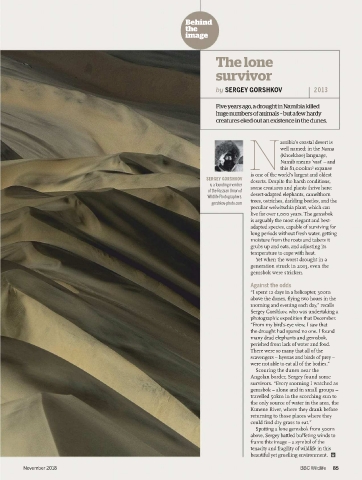
Spotting a lone gemsbok from 300m
above, Sergey battled buffeting winds to
frame this image – a symbol of the
tenacity and fragility of wildlife in this
beautiful yet gruelling environment.
November 2018 BBC Wildlife 85

