


Page 170 - (DK Eyewitness) Travel Guide - Italy
P. 170
168   І   NOR THEAST  IT AL Y


                                               craftsmanship that flourished in
                                               the city from the 2nd century AD.
                                               Additional examples of
                                               mosaics and stone carvings
                                               from the 1st to 3rd centuries
                                               are on display in this museum,
                                               together with glass, amber and
                                               a collection of flies, beautifully
                                               worked in gold, that formed
                                               the adornment of a Roman
                                               matron’s veil.

                                               E Museo Paleocristiano
                                               Località Monastero. Tel 0431 911 31.
                                               Open 8:30am–1:45pm Thu. 7 ^
                                               This museum, which stands
                                               not far from Aquileia’s ancient
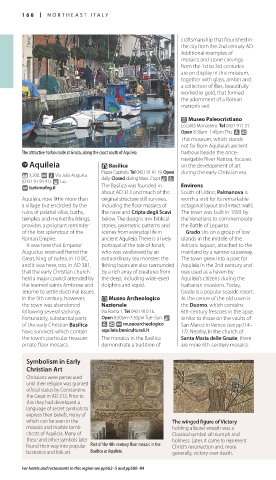
       The attractive harbourside at Grado, along the coast south of Aquileia  harbour beside the once-
                                               navigable River Natissa, focuses
       o Aquileia          T Basilica          on the development of art
                           Piazza Capitolo. Tel 0431 91 97 19. Open   during the early Christian era.
       * 3,300. @ n Via Julia Augusta   daily. Closed during Mass. Crypt & 7
       (0431 91 94 91). ( Tue.
       ∑ turismofvg.it     The Basilica was founded in   Environs
                           about AD 313 and much of the   South of Udine, Palmanova is
       Aquileia, now little more than    original structure still survives,   worth a visit for its remarkable
       a village but encircled by the   including the floor mosaics of   octagonal layout and intact walls.
       ruins of palatial villas, baths,   the nave and Cripta degli Scavi   The town was built in 1593 by
       temples and market buildings,   below. The designs mix biblical   the Venetians to commemorate
       provides a poignant reminder    stories, geometric patterns and   the Battle of Lepanto.
       of the lost splendour of the   scenes from everyday life in     Grado sits on a group of low
       Roman Empire.       ancient Aquileia. There is a lively   islands in the middle of the
         It was here that Emperor   portrayal of the tale of Jonah,   Adriatic lagoon, attached to the
       Augustus received Herod the   who was swallowed by an   mainland by a narrow causeway.
       Great, King of Judea, in 10 BC,   extraordinary sea monster: the   The town grew into a port for
       and it was here, too, in AD 381,   fishing boats are also surrounded  Aquileia in the 2nd century and
       that the early Christian church   by a rich array of creatures from   was used as a haven by
       held a major council attended by   the deep, including wide-eyed   Aquileia’s citizens during the
       the learned saints Ambrose and   dolphins and squid.  barbarian invasions. Today,
       Jerome to settle doctrinal issues.      Grado is a pop ular sea side resort.
       In the 5th century, however,    E Museo Archeologico   At the centre of the old town is
       the town was abandoned   Nazionale      the Duomo, which contains
       following several sackings.   Via Roma 1. Tel 0431 910 16.    6th-century frescoes in the apse,
       Fortunately, substantial parts    Open 8:30am–7:30pm Tue–Sun. &   similar to those on the vaults of
       of the early Christian Basilica   7 ^ ∑ museoarcheologico   San Marco in Venice (see pp114–
       have survived, which contain   aquileia.beniculturali.it  17). Nearby, in the church of
       the town’s particular treasure:   The mosaics in the Basilica   Santa Maria delle Grazie, there
       ornate floor mosaics.  demonstrate a tradition of   are more 6th-century mosaics.
        Symbolism in Early
        Christian Art
        Christians were persecuted
        until their religion was granted
        official status by Constantine
        the Great in AD 313. Prior to
        this they had developed a
        language of secret symbols to
        express their beliefs, many of
        which can be seen in the             The winged figure of Victory
        mosaics and marble tomb              holding a laurel wreath was a
        chests of Aquileia. Many of          Classical symbol of triumph and
        these and other symbols later        holiness. Later, it came to represent
        found their way into popular   Part of the 4th-century floor mosaic in the   Christ’s resurrection and, more
        bestiaries and folk art.  Basilica at Aquileia  generally, victory over death.

       For hotels and restaurants in this region see pp562–5 and pp580–84


   168-169_EW_Italy.indd   168                                4/4/17   5:33 PM
     Eyewitness Travel   LAYERS PRINTED:
     Catalogue template    “UK” LAYER
     (Source v1.2)
     Date 12th June 2012
     Size 125mm x 217mm

