


Page 221 - (DK Eyewitness) Travel Guide - Italy
P. 221
V ALLE  D ’ A OST A  AND  PIEDMONT  І   219


                                originally stood about   altered many times since.
                                2.5 m (8 ft) higher than   The interior is Gothic, with finely
                                at present. Also worth a   carved 15th-century choir stalls,
                                look is the 20 m- (65 ft-)   and floor mosaics. Next door,
                                high façade of the   the Museo del Tesoro contains
                                Roman Theatre. A little   a rich collection of statuettes
                                to the north is the   and reliquaries, and a number
                                elliptical amphitheatre,   of impressive medieval tombs.
                                although this is almost
                                completely buried    R Sant’Orso
       The 12th-century cloister, with 40 carved columns of   apart from three   Via Sant’Orso. Open daily. 7
       darkened marble, in Sant’Orso  columns, which form   East of the town walls is the
                                part of the convent of   architectural highlight of Aosta:
       5 Aosta             San Giuseppe. In the old town,   a medieval complex of church
                           next to the cathedral, lies the   buildings. Sant’Orso itself has an
       * 35,000. V @ n Piazza Porta
       Pretoria 3 (0165 23 66 27). ( Tue.   Roman Forum, or marketplace,   unusual Gothic façade with a
       ∑ lovevda.it        with its huge crypto porticus:    narrow, tall portal. The interior
                           the function of this impressive   has 11th-century frescoes,
       Lying on a plain surrounded by   underground gallery remains   a crypt hold ing the tomb of
       dramatic mountains, the town   the subject of speculation.   St Orso, patron saint of Aosta,
       of Aosta provides a remarkable          and a beautiful cloister with
       mixture of ancient culture and          carved columns and capitals.
       spectacular scenery. The
       Romans cap tured it from                Environs
       the Salassian Gauls in                  The castle at Fénis(see p188),
       25 BC, and Aosta is still               12 km (8 miles) east, is one of
       dotted with fine Roman                  the few castles in the Aosta
       architecture built in                   valley with a well-preserved
       honour of Emperor                       interior, including beautiful
       Augustus – indeed the                   frescoes and wooden galleries.
       town was once called Augusta            Issogne, 38 km (23 miles)
       Praetoria, its name only   Detail of a medieval mosaic on the    south east, is the setting for
       evolving into Aosta over the   floor of Aosta’s Cattedrale  another highly decorated castle,
       centuries. The medieval town            remod elled around 1490. It has
       was later fortified by the   R Cattedrale  many frescoes and decorative
       Challant family and then by the   Piazza Papa Giovanni XXIII. Open   motifs, including an octagonal
       Dukes of Aosta, who added   6:30am– 12:30pm, 2–7:30pm Mon–Fri,   fountain with a centrepiece in
       towers to the old Roman walls.  7am–noon, 2–6pm Sat & Sun (early   the shape of a pomegranate tree.
         Modern Aosta is a bustling   Sep–Easter: 6:30am–noon, 3–7pm).
       crossroads for local industries   Museo del Tesoro: Tel 0165 404 13.   + Castello di Fénis
       and tourists on their way to the   Open 3–5:30pm Sat & Sun. Closed   Fénis. Tel 0165 76 42 63. Open daily.
       mountains. The centre, how ever,   during religious services. &  Closed Tue (Oct–Feb), 1 Jan, 25 Dec. &
       still consists of a delightful grid   This relatively modest shrine to   + Castello di Issogne
       of large squares and surprising   St John the Baptist was first built   Issogne. Tel 0125 92 93 73. Open daily.
       architectural treasures, which   in the 12th century, but has been   Closed Wed (Oct–Feb), 1 Jan, 25 Dec. &
       justify Aosta’s nickname of
       “Rome of the Alps”.
       T Roman Ruins
       Roman Theatre: Via Baillage. Open
       9am–7pm daily (Mar: to 6pm; Oct:
       to 6:30pm; Nov–Feb: to 5pm).
       Roman Forum: Piazza Papa Giovanni
       XXIII. Open daily.
       In Roman times, entry to Aosta
       was over the bridge to the east
       of the town (beyond the modern
       bridge) and through the Arch of
       Augustus. This triumphal arch is
       today marred by a roof added in
       the 18th century. Ahead stands
       the Porta Pretoria, its double
       row of stone arches flanked by
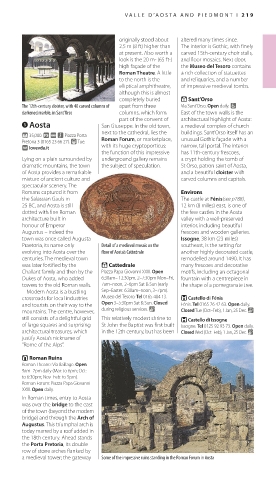
       a medieval tower; the gateway   Some of the impressive ruins standing in the Roman Forum in Aosta


   218-219_EW_Italy.indd   219                                4/4/17   5:33 PM

