


Page 29 - (DK Eyewitness) Travel Guide - Italy
P. 29
A POR TR AIT OF IT AL Y 27
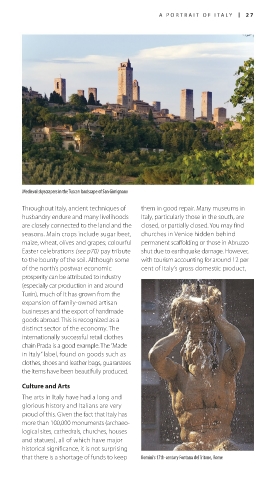
Medieval skyscrapers in the Tuscan landscape of San Gimignano
Throughout Italy, ancient techniques of them in good repair. Many museums in
husbandry endure and many livelihoods Italy, particularly those in the south, are
are closely connected to the land and the closed, or partially closed. You may find
seasons. Main crops include sugar beet, churches in Venice hidden behind
maize, wheat, olives and grapes; colourful permanent scaffolding or those in Abruzzo
Easter celebrations (see p70) pay tribute shut due to earthquake damage. However,
to the bounty of the soil. Although some with tourism accounting for around 12 per
of the north’s postwar economic cent of Italy’s gross domestic product,
prosperity can be attributed to indus try
(especially car production in and around
Turin), much of it has grown from the
expansion of family-owned artisan
businesses and the export of handmade
goods abroad. This is recognized as a
distinct sector of the economy. The
internationally successful retail clothes
chain Prada is a good example. The “Made
in Italy” label, found on goods such as
clothes, shoes and leather bags, guarantees
the items have been beautifully produced.
Culture and Arts
The arts in Italy have had a long and
glorious history and Italians are very
proud of this. Given the fact that Italy has
more than 100,000 monuments (archaeo-
logical sites, cathed rals, churches, houses
and statues), all of which have major
historical significance, it is not surprising
that there is a shortage of funds to keep Bernini’s 17th-century Fontana del Tritone, Rome
024-029_EW_Italy.indd 27 4/4/17 5:31 PM

