


Page 398 - (DK Eyewitness) Travel Guide - Italy
P. 398
396 ROME AND LAZIO
Exploring the Roman Forum
To appreciate the layout of the Roman Forum before
wandering through its confusing patchwork of ruined
temples, triumphal arches and basilicas, it is best to view the
whole area from the Capitoline Hill above. From there you can
make out the more substantial ruins, and the course of the Via
Sacra (Sacred Way), the route followed through the Forum by
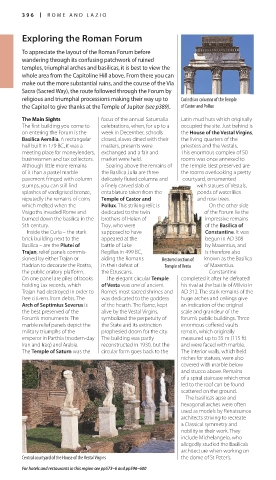
religious and triumphal processions making their way up to Corinthian columns of the Temple
the Capitol to give thanks at the Temple of Jupiter (see p389). of Castor and Pollux
The Main Sights focus of the annual Saturnalia Latin mud huts which originally
The first building you come to celebrations, when, for up to a occupied the site. Just behind is
on entering the Forum is the week in December, schools the House of the Vestal Virgins,
Basilica Aemilia. A rect angular closed, slaves dined with their the living quarters of the
hall built in 179 BC, it was a masters, presents were priestess and the Vestals.
meeting place for moneylenders, exchanged and a fair and This enormous complex of 50
businessmen and tax collectors. market were held. rooms was once annexed to
Although little more remains Soaring above the remains of the Temple. Best preserved are
of it than a pastel marble the Basilica Julia are three the rooms overlooking a pretty
pavement fringed with column delicately fluted columns and courtyard, ornamented
stumps, you can still find a finely carved slab of with statues of Vestals,
splashes of verdigrised bronze, entablature taken from the ponds of waterlilies
reputedly the remains of coins Temple of Castor and and rose trees.
which melted when the Pollux. This striking relic is On the other side
Visigoths invaded Rome and dedicated to the twin of the Forum lie the
burned down the basilica in the brothers of Helen of impressive remains
5th century. Troy, who were of the Basilica of
Inside the Curia – the stark supposed to have Constantine. It was
brick building next to the appeared at the begun in AD 308
Basilica – are the Plutei of battle of Lake by Maxentius, and
Trajan, relief panels commis Regillus in 499 BC, is therefore also
sioned by either Trajan or aiding the Romans Restored section of known as the Basilica
Hadrian to decorate the Rostra, in their defeat of Temple of Vesta of Maxentius.
the public oratory platform. the Etruscans. Constantine
On one panel are piles of books The elegant circular Temple completed it after he defeated
holding tax records, which of Vesta was one of ancient his rival at the battle of Milvio in
Trajan had destroyed in order to Rome’s most sacred shrines and AD 312. The stark remains of the
free citizens from debts. The was dedicated to the goddess huge arches and ceilings give
Arch of Septimius Severus is of the hearth. The flame, kept an indication of the original
the best preserved of the alive by the Vestal Virgins, scale and grandeur of the
Forum’s monuments. The symbolized the perpetuity of forum’s public buildings. Three
marble relief panels depict the the State and its extinction enormous coffered vaults
military triumphs of the prophesied doom for the city. remain, which originally
emperor in Parthia (modernday The building was partly measured up to 35 m (115 ft)
Iran and Iraq) and Arabia. reconstructed in 1930, but the and were faced with marble.
The Temple of Saturn was the circular form goes back to the The interior walls, which held
niches for statues, were also
covered with marble below
and stucco above. Remains
of a spiral staircase which once
led to the roof can be found
scattered on the ground.
The basilica’s apse and
hexagonal arches were often
used as models by Renaissance
architects striving to recreate
a Classical symmetry and
nobility in their work. They
include Michelangelo, who
allegedly studied the Basilica’s
architecture when working on
Central courtyard of the House of the Vestal Virgins the dome of St Peter’s.
For hotels and restaurants in this region see pp573–6 and pp596–600
396-397_EW_Italy.indd 396 26/04/16 4:31 pm

