


Page 467 - (DK Eyewitness) Travel Guide - Italy
P. 467
ROME AND LAZIO 465
LAZIO
Lying between the Apennines and the Tyrrhenian Sea,
Lazio is a varied region of volcanic lakes, mountains,
ravines, vineyards and olive groves. Before the rise of
Rome, it was populated by the Etruscans and various Italic
tribes, including the Latins, after whom the region is named.
Besides its archaeological sites, Lazio also offers skiing,
and swimming and water sports in the lakes and sea.
Lazio was inhabited at least 60,000 years patricians built lavish villas in the
ago, although the first signs of a substantial surrounding countryside.
civilization date back to the 10th century The early Middle Ages saw the rise of
BC. By the 7th century BC a flourishing the Church’s temporal power and, with
Etruscan and Sabine civilization based on the foundation of monasteries at Subiaco
trade and agriculture existed in the north, and Montecassino, Lazio became the
while the region’s southern margins were cradle of western monasticism, and
colonized by the Latins, Volsci and Hernici. even tually part of the Papal States. In the
History mingles with myth in the writings 16th and 17th centuries, wealthy papal
of Virgil, who describes how Aeneas landed families competed with one another to
in Lazio, where he married the daughter of build luxurious villas and gardens, hiring
the king of the Latins. Romulus and Remus some of the best architects of the
(legendary founders of Rome) were Renaissance and Baroque.
descendants of this alliance. Throughout its history, however, Lazio
With the rise of Rome as a power, the has been eclipsed and neglected by
Etruscan and Latin peoples were, in time, Rome. The Pontine marshes were a
overwhelmed and the focus of the region malaria-ridden swamp until the 1920s,
turned to the city of Rome. Great roads when Mussolini had them drained and
and aqueducts extended out of the brought new roads and agricultural
city like spokes of a wheel, and wealthy improvements to the area.
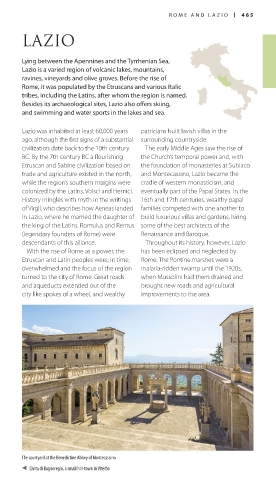
The courtyard at the Benedictine Abbey of Montecassino
Civita di Bagnoregio, a small hill-town in Viterbo
464-465_EW_Italy.indd 465 05/05/2017 10:09

