


Page 484 - (DK Eyewitness) Travel Guide - Italy
P. 484
482 S ou T heRN IT a ly
Understanding the Architecture
of Southern Italy
The Romanesque style of southern Italy owes much to the
Normans, who in the 11th century brought from France
both form and style in architecture and sculpture. In the
southeast, the style has hefty Byzantine overtones; in Sicily
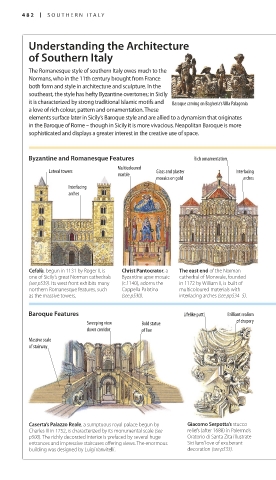
it is characterized by strong traditional Islamic motifs and Baroque carving on Bagheria’s Villa Palagonia
a love of rich colour, pattern and ornamentation. These
elements surface later in Sicily’s Baroque style and are allied to a dynamism that originates
in the Baroque of Rome – though in Sicily it is more vivacious. Neapolitan Baroque is more
sophisticated and displays a greater interest in the creative use of space.
Byzantine and Romanesque Features Rich ornamentation
Multicoloured
Lateral towers Glass and plaster Interlacing
marble
mosaics on gold arches
Interlacing
arches
Cefalù, begun in 1131 by Roger II, is Christ Pantocrator, a The east end of the Norman
one of Sicily’s great Norman cathedrals Byzantine apse mosaic cathedral of Monreale, founded
(see p539). Its west front exhibits many (c.1140), adorns the in 1172 by William II, is built of
northern Romanesque features, such Cappella Palatina multicoloured materials with
as the massive towers. (see p530). interlacing arches (see pp534–5).
Baroque Features Lifelike putti Brilliant realism
Sweeping view Bold statue of drapery
down corridor of lion
Massive scale
of stairway
Caserta’s Palazzo Reale, a sumptuous royal palace begun by Giacomo Serpotta’s stucco
Charles III in 1752, is characterized by its monumental scale (see reliefs (after 1688) in Palermo’s
p500). The richly decorated interior is prefaced by several huge Oratorio di Santa Zita illustrate
entrances and impressive staircases offering views. The enormous Sicilians’ love of exuberant
building was designed by Luigi Vanvitelli. decoration (see p533).
482-483_EW_Italy.indd 482 20/03/15 10:51 am

