


Page 501 - (DK Eyewitness) Travel Guide - Italy
P. 501
NAPLES AND C A MP ANIA 499
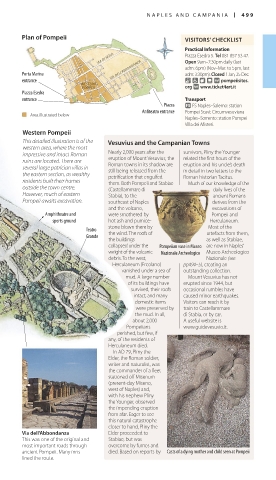
Plan of Pompeii VISITORS’ CHECKLIST
Practical Information
VIA DI NOLA Piazza Esedra 5. Tel 081 857 53 47.
Open 9am–7:30pm daily (last
Porta Marina VIA DELL’ABBONDANZA adm: 6pm) (Nov–Mar: to 5pm, last
adm: 3:30pm). Closed 1 Jan, 25 Dec.
entrance & 7 8 - ∑ pompeii sites.
WESTERN
POMPEII org ∑ www.ticket4art.it
Piazza Esedra
entrance Transport
Piazza V FS Naples–Salerno: station
. House of the Vettii
The villa of the wealthy merchants Aulus Area illustrated below Anfiteatro entrance Pompei Scavi; Circum vesuviana
Naples–Sorrento: station Pompei
Vettius Conviva and Aulus Vettius
Restitutus contains frescoes (see pp48–9). Villa dei Misteri.
It is currently closed for renovation. Western Pompeii
This detailed illustration is of the Vesuvius and the Campanian Towns
western area, where the most
impressive and intact Roman Nearly 2,000 years after the survivors, Pliny the Younger
ruins are located. There are eruption of Mount Vesuvius, the related the first hours of the
eruption and his uncle’s death
Roman towns in its shadow are
several large patrician villas in still being released from the in detail in two letters to the
the eastern section, as wealthy petrification that engulfed Roman historian Tacitus.
residents built their homes them. Both Pompeii and Stabiae Much of our knowledge of the
outside the town centre. (Castellammare di daily lives of the
V I A S T A B I A N A
However, much of eastern Stabia), to the ancient Romans
Pompeii awaits excavation. southeast of Naples derives from the
and the volcano, excavations of
Amphitheatre and were smothered by Pompeii and
sports ground hot ash and pumice- Herculaneum.
Most of the
Teatro stone blown there by artefacts from them,
the wind. The roofs of
Grande
the buildings as well as Stabiae,
collapsed under the Pompeiian vase in Museo are now in Naples’
VICOLO DEL LUPANARE
weight of the volcanic Nazionale Archeologico Museo Archeologico
Nazionale (see
debris. To the west, pp494–5), creating an
V I A D E L L ’ A B B O N D A N Z A vanished under a sea of outstanding collection.
Herculaneum (Ercolano)
mud. A large number
Mount Vesuvius has not
erupted since 1944, but
of its buildings have
occasional rumbles have
survived, their roofs
intact, and many
Visitors can reach it by
domestic items
train to Castellammare
were preserved by caused minor earthquakes.
the mud. In all, di Stabia, or by car.
about 2,000 A useful website is
Pompeiians www.guidevesuvio.it.
perished, but few, if
any, of the residents of
Herculaneum died.
In AD 79, Pliny the
Elder, the Roman soldier,
writer and naturalist, was
the commander of a fleet
stationed off Misenum
(present-day Miseno,
west of Naples) and,
with his nephew Pliny
the Younger, observed
the impending eruption
from afar. Eager to see
this natural catastrophe
closer to hand, Pliny the
Via dell’Abbondanza Elder proceeded to
This was one of the original and Stabiae, but was
most important roads through overcome by fumes and
ancient Pompeii. Many inns died. Based on reports by Casts of a dying mother and child seen at Pompeii
lined the route.
498-499_EW_Italy.indd 499 4/5/17 9:31 AM

