


Page 634 - (DK Eyewitness) Travel Guide - Italy
P. 634
632 SUR VIV AL GUIDE
Travelling within Cities
The best ways of getting around Italian cities differ from place
to place. In Rome buses are most useful, in Milan the metro is
more efficient, and in Venice you will need to take a boat to
get about. Trams still run in some cities, such as Milan and
Rome. Cars are a liability almost everywhere, unlike walking,
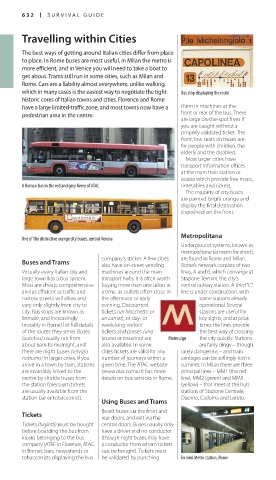
which in many cases is the easiest way to negotiate the tight Bus stop displaying the route
historic cores of Italian towns and cities. Florence and Rome
have a large limited-traffic zone, and most towns now have a them in machines at the
pedestrian area in the centre. front or rear of the bus. There
are large on-the-spot fines if
you are caught without a
properly validated ticket. The
front, low seats on buses are
for people with children, the
elderly and the disabled.
Most larger cities have
transport information offices
at the main train station or
piazza which provide free maps,
A Roman bus in the red and grey livery of ATAC timetables and tickets.
The majority of city buses
are painted bright orange and
display the final destination
(capolinea) on the front.
Metropolitana
One of the distinctive orange city buses, central Verona
Underground systems, known as
metropolitana (la metro for short),
company’s sticker. A few cities are found in Rome and Milan.
Buses and Trams also have on-street vending Rome’s network consists of two
Virtually every Italian city and machines around the main lines, A and B, which converge at
large town has a bus system. transport hubs. It is often worth Stazione Termini, the city’s
Most are cheap, comprehensive buying more than one ticket at central railway station. A third “C”
and as efficient as traffic and a time, as outlets often close in line is under con struc tion, with
narrow streets will allow and the afternoon or early some stations already
vary only slightly from city to evening. Discounted opera tional. Several
city. Bus stops are known as tickets (un blocchetto or stations are useful for
fermate, and increasingly un carnet), or day- or key sights, and at peak
(notably in Rome) list full details week-long visitors’ times the lines provide
of the routes they serve. Buses tickets and passes (una the best way of crossing
(autobus) usually run from tessera or tesserino) are Metro sign the city quickly. Stations
about 6am to midnight, and also available. In some are fairly dingy – though
there are night buses (servizio cities tickets are valid for any rarely dangerous – and train
notturno) in larger cities. If you number of journeys within a carriages can be stiflingly hot in
arrive in a town by train, stations given time. The ATAC website summer. In Milan there are three
are invariably linked to the (www.atac.roma.it) has more principal lines – MM1 (the red
centre by shuttle buses from details on bus services in Rome. line), MM2 (green) and MM3
the station forecourt (tickets (yellow) – that meet at the hub
are usually available from the stations of Stazione Centrale,
station bar or tobacconist). Duomo, Cadorna and Loreto.
Using Buses and Trams
Board buses via the front and
Tickets
rear doors, and exit via the
Tickets (biglietti) must be bought central doors. Buses usually only
before boarding the bus from have a driver and no conductor
kiosks belonging to the bus (though night buses may have
company (ATAF in Florence, ATAC a conductor from whom tickets
in Rome), bars, newsstands or can be bought). Tickets must
tobacconists displaying the bus be validated by punching Termini Metro station, Rome
632-633_EW_Italy.indd 632 4/5/17 9:32 AM
Eyewitness Travel LAYERS PRINTED:
Practical template “UK” LAYER
(Source v1.1)
Date 13th August 2012
Size 125mm x 217mm

