


Page 9 - (DK Eyewitness) Travel Guide - Italy
P. 9
HOW T O USE THIS GUIDE 7
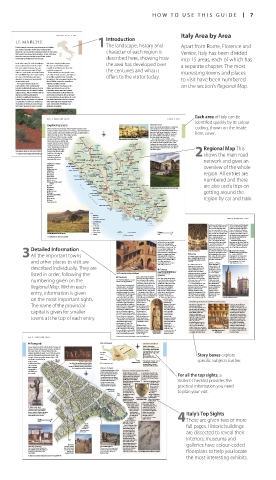
CENTR AL IT AL Y 369 Italy Area by Area
Introduction
LE MARCHE
Tucked away in a remote corner between the Adriatic 1The landscape, history and Apart from Rome, Florence and
Sea and the Apennine mountains, Le Marche (the
Marches) is an enchanting rural patchwork of old towns, character of each region is Venice, Italy has been divided
hill country and long, sandy beaches. In pre-Christian
times the area was settled by the Piceni, a tribe
eventually assimilated by the Romans. described here, showing how into 15 areas, each of which has
In the 4th century BC, exiles from Magna old squares in Italy. Smaller towns the area has developed over
Graecia colonized much of the region. like San Leo and Urbania and the a sep arate chapter. The most
The most notable town was Ancona, repub lic of San Marino also boast fine
also the northernmost point of Greek medieval monuments. the centuries and what it
influence on the Italian peninsula. During Today probably as many people come interesting towns and places
the early Middle Ages the region marked to Le Marche for its beaches and towns as
the edge of the Holy Roman Empire, for its hilly, unspoilt inter ior. Especially offers to the visitor today.
giving rise to its present name (march beautiful are the snowcapped peaks of the to visit have been num bered
meant border area). Monti Sibillini, situated in magnificent
The region’s historical peak was walking and skiing country.
reached in the 15th century under Regional cuisine encompasses the on the section’s Regional Map.
Federico da Montefeltro, whose court at truffles and robust cheeses of the
Urbino became one of Europe’s leading mountains, tender hams and salamis,
cultural centres. Much of Urbino’s former olive ascolane (olives stuffed with meat
grandeur survives, particularly in and herbs) and brodetto, fish soup made
Federico’s magnificent Renaissance in several versions up and down the coast.
Palazzo Ducale, now home to a regional Dry, white Verdicchio is the best known
art collection. Ascoli Piceno is almost as wine, although more unusual names,
enchanting as Urbino, its central Piazza such as Bianchello del Metauro, are
del Popolo among the most evocative gaining in popularity.
Each area of Italy can be
466 R o M e AN d L A zio L A zio 467
identified quickly by its colour
Exploring Lazio Getting Around
Rome’s two international airports at Fiumi cino coding, shown on the inside
Much of Lazio’s landscape was formed by the eruption of four and Ciampino serve the region. The main
volcanoes, which showered the area with lava. Lakes formed in the motorways are the Autostrada del Sole Firenze–
craters, and the soil, rendered fertile by the lava, nourished vines, Roma (A1) and Roma–Napoli (A1–E45), and front cover.
the Roma–L’Aquila (A24–E80). The ring road
olives, fruit and nut trees. The volcanic activity (raccordo anulare) around Rome connects
also left Lazio with hot springs, notably Siena the motorways and main roads.
around Tivoli, Viterbo and Fiuggi. Rome Whitewashed houses in Sperlonga’s Old Town The Lazio bus service, COTRAL, serves
dominates the area, dividing the all the main towns with changeover points for
wooded hills of the north from the Acquapendente Ascoli Piceno the smaller locations in Rome and at Latina,
reclaimed Pontine marshes in the Firenze Accumoli Frosinone, Viterbo and Rieti. Train routes into
the region from other Italian cities are efficient,
south. Swimming and sailing are although within Lazio the services are slower
possible in lakes Bracciano, Monti Volsini Bolsena Amatrice and less frequent. Regional Map This
Cittareále
A field of poppies and olive trees in the heart of Le Marche’s countryside Bolsena and Albano, while Valentano Lago di Bagnoregio Terni Leonessa
Bolsena
Lazio’s best beaches lie
A view of the Piazza del Popolo, built in traventine marble, in the town of Ascoli Piceno Farnese MONTEFIASCONE Posta 2shows the main road
between Gaeta and Cellere Terni Reatini Monti
Sabaudia in the Parco Grosseto Fiora BOMARZO Orte Monte Terminillo
2216m
Nazionale del Circeo. TUSCANIA VITERBO Villa Lante Greccio Rieti Antrodoco network and gives an
Sights at a Glance Montalto Montalto di Castro Vetralla Lago Magliano Monte Nuria L’Aquila
Sabina
1888m
Marina
1 Tuscania Riva dei Tarquini Marta di Vico CAPRAROLA Monti Sabini Turano Concerviano
2 Viterbo TARQUINIA Capranica Civita Tevere Salto Fiamignano overview of the whole
Lago del
3 Montefiascone Lido di Tarquinia Sutri Castellana Farfa Lago di Borgorose
4 Bomarzo Vejano Turano Salto
5 Caprarola Allumiere LAKE Monti Sabatini Morlupo Montelibretti region. All entries are
6 Tarquinia Civitavecchia Monti BRACCIANO Riano Moricone Orvinio
7 Cerveteri della Tolfa Bracciano Anguillara Licenza
8 Lake Bracciano Avezzano
9 Ostia Antica Santa Marinella Isola Farnese Mentana Guidonia Cervara di Roma numbered and there
0 Frascati and the Castelli CERVETERI TIVOLI
Romani Ladispoli Monti Simbruini
q Tivoli Maccarese Vatican City Villa Adriana SUBIACO Avezzano are also useful tips on
Arcinazzo Romano
w Palestrina Roma (Rome) LAZIO The medieval Porta del Sole (Sun Gate), at the entrance of Palestrina
e Subiaco Focene PALESTRINA M o n t i E r n i c i
r Montecassino Colli FRASCATI Guarcino getting around the
t Anagni OSTIA ANTICA Castel Gandolfo Albani C i o c i a r i a Alatri
y Sermoneta and Ninfa M A R T I R R E N O Albano Nemi ANAGNI Sora Monte Petroso
2247m
Lido di Ostia
u Terracina Pomézia Velletri Segni Ferentino Picinisco
i Sperlonga Tor Vaianica Cisterna Sacco Frosinone Arpino region by car and train.
o Gaeta di Latina Monti Lepini Arce Atina Cardito
Rome pp386–463 Aprilia Ninfa Pofi Ceprano Monte Cairo
SERMONETA
Lavinio Lido di Enea A g r o P o n t i n o Prossedi 1669m MONTECASSINO
Anzio Latina Priverno Pontecorvo
Lago Pontinia Sonnino Pico Liri
di Fogliano Monti Ausoni Esperia
Key Fondi Garigliano Napoli
Motorway Sabaudia Lago di Sisto TERRACINA Itri Monti Aurunci
Major road Sabaudia Formia Minturno
Road under construction 262 І CENTR AL IT AL Y SPERLONGA EMILIA-ROM A GNA І 263
Capo Circeo
Secondary road GAETA Pozzuoli
Minor road Golfo
frieze of The Deposition (1178)
Scenic route di Gaeta 2 Castell’Arquato south transept features a carved Both Correggio and Parmigianino
are represented in the palace’s
Main railway Piacenza. * 4,500. @ n Piazza by Benedetto Antelami, who Galleria Nazionale, which also
Municipio 1 (0523 80 32 15). ( Mon.
Minor railway was also responsible for much houses works by Fra Angelico,
Isola
Tucked into the folded hills
Regional border Isola Zannone 0 kilometres 15 of the exquisite Baptistry (1196) El Greco and Bronzino, and two
The Tolfa hills southwest of Lake Bracciano Summit Palmarola 0 miles between Fidenza and Piacenza, just south of the cathedral. The paintings by Ludovico Carracci:
10
Isole Ponziane Castell’Arquato is one of the reliefs inside and outside the the Apostles at the Sepulchre and
For additional map symbols see back flap prettiest villages in the latter – particularly those the Funeral of the Virgin (both
countryside south of the Po. describing the months of the late 16th century).
Day visitors come at the year – are among the most The Museo Archeologico
weekends to escape Emilia’s important of their age in Italy. Nazionale, on the lower floor, has
larger cities, thronging the East of the Duomo is the exhibits from Velleia, an Etruscan
restaurants and bars around the church of San Giovanni necropolis, and from prehistoric
Detailed Information beautiful Piazza Matteotti. The Interior of Parma Baptistry Evangelista (rebuilt 1498–1510) sites in the hills around Parma.
best medieval building on the
whose dome features a fresco
E Camera di Correggio
(c.1520) of the Vision of St John at
piazza is the 13th-century
Palazzo Pretorio, a Romanesque Patmos by Correggio. Frescoes Via Melloni. Tel 0521 23 33 09. Open
3All the important towns basilica. The impressive Rocca 4 Parma by Parmigianino can be seen Tue–Sun (am only). & 7
Originally the refectory of the
here and in the 16th-century
Viscontea (14th century), a
* 190,000. V @ n Via Melloni 1a
church of Madonna della
former fortress, is on Piazza del
Benedictine convent of San
(0521 21 88 89). ( Wed & Sat; Thu
and other places to visit are Municipio. The village’s hilltop (flea market). ∑ turismo.comune. Steccata on Via Dante. Paolo, this room was frescoed
parma.it
by Correggio in 1518 with
site offers good views,
P Palazzo Pilotta
particularly over the verdant
mythological scenes.
Piazzale della Pilotta 15.
Arda valley to the east.
Few Italian towns are as
described individually. They are 3 Fidenza prosperous as Parma, not Galleria: Tel 0521 23 36
only a byword for fine food
17. Open Tue–Sun am.
& 7 Museo: Tel 0521
and good living but also a
23 37 18. Open Tue–Sat
listed in order, following the The 13th-century Palazzo Pretorio in Castell’Arquato has a rather leaden Lombard- Parma. * 25,000. V @ n Piazza treasure trove of excellent am, Sun pm. & 7
paintings, superlative sculpture
Duomo 16 (0524 833 77).
This vast palace was
and fine medieval buildings.
( Wed & Sat.
It boasts one of Italy’s top
built for the Farnese
1 Piacenza
numbering given on the * 105,000. V @ n Piazza Cavalli Romanesque exterior (begun Like many towns hugging the opera houses and a panoply family during the
of elegant shops and first-rate
in 1122), and a 14th-century
line of the Po, Fidenza owed its
1500s and rebuilt
early prominence to the Via
after bomb damage
campanile. The interior features
7 (0523 32 93 24). ( Wed & Sat.
bars and restaurants.
Aemilia (the old Roman road).
Guercino’s painted cupola and
The Lombard-Romanesque
from World War II.
Regional Map. Within each Piacenza traces its history back medieval frescoes. There are The town assumed greater Duomo on Piazza Duomo, It comprises several
among the greatest in northern
parts, including the
importance as a medieval
to Roman times. Located near
also frescoed saints near the
the Po, it served as a fortified
Teatro Farnese
main door, painted to resemble
Italy, is renowned for the
way station for pilgrims en
entry, information is given camp protecting the Emilian members of the congregation. route to Rome. Today Fidenza is painting that fills its main (1628), a copy of
plain from invasion. The centre
visited for its superb Duomo
The Museo Civico offers an
Palladio’s ravishing
cupola, the Assumption (1526–
on Piazza Duomo (13th
theatre in Vicenza,
30) by Antonio da Correggio.
eclectic mixture of sculpture and
is still based on the Roman plan.
Piacenza has a pleasantly paintings – the star among these century), a composite piece The nave is adorned with the built entirely
on the most important sights. understated old centre full of is the Madonna and Child with of architecture that embraces work of Correggio’s pupils. The of wood. Campanile and Baptistry in Parma
John the Baptist by
Lombard, Gothic
fine medieval and Renaissance
buildings. Pride of place goes to
and transitional
Botticelli (1444–1510).
two bronze equestrian statues There is also an Romanesque The Making of Parmesan Cheese and Parma Ham
The name of the provincial in the central Piazza Cavalli, the armoury and elements. The most No cheese is as famous or as ham owes its excel lence to
work of the 17th-century sculptor archaeology section.
vital to Italy’s cuisine as
immediately eye-
techniques perfected over
catching feature is
Parmesan (Parmigiano). There
The highlight here is
Francesco Mochi, a pupil of
many years and to the special
capital is given for smaller Giambologna. Lauded as master- the so-called Fegato the opulent façade, are two types: the superior conditions in which it is cured.
It is made from pigs fattened
Parmigiano-Reggiano and the
di Piacenza, an
most probably
pieces of Baroque sculpture,
lower-quality Grana. The
on whey left over from the
Etruscan bronze
the statues represent Alessandro
created by the
cheese is made using
making of Parmesan cheese.
craftsmen who
Farnese, a soldier of fortune, and representation of
towns at the top of each entry. his son, Ranuccio: both were the sheep livers once worked with techniques that have barely The meat has a character that
requires little more than salt
altered in centuries. Partially
rulers of 16th-century Piacenza.
used by priests for
Benedetto Antelami
and pepper to produce the
skimmed milk is added to
Behind the statues is the red-
divination, inscribed
on Parma’s Duomo.
brick Palazzo del Comune, with deities’ names. Inside, the walls are whey, to promote famous prosciutto crudo. The
breezy hills of Langhirino,
fermentation, and rennet is
also known as “Il Gotico”, an dotted with used to curdle the milk. The south of Parma, are ideal for
evocatively battlemented E Museo Civico fragments of cheese is then salted and curing the hams, which are
Lombard-Gothic palace begun Palazzo Farnese, Piazza medieval frescoes, shaped. Parmesan is not only aged for up to ten months.
at the end of the 13th century. Cittadella. Tel 0523 49 26 while the crypt used in cooking but is delicious Each ham is branded with the
It is one of Italy’s most beautiful 61. Open Tue –Sun (Tue– contains the relics of eaten on its own, or with pears Shop selling Parmesan cheese five-pointed crown of the old
medieval buildings. The Duomo, Thu am only). Closed Detail from façade of San Donnino, the – an Italian speciality. Parma and Parma ham Duchy of Parma.
at the end of Via XX Settembre, public hols. & Duomo in Fidenza Duomo’s patron.
NAPLES AND C A MP ANIA 499
498 SOUTHERN IT AL Y For hotels and restaurants in this region see p562–77 and pp580–605
2 Pompeii Plan of Pompeii VISITORS’ CHECKLIST
An earthquake in AD 62, which shook Pompeii and Practical Information
Piazza Esedra 5. Tel 081 857 53 47.
damaged many buildings, was merely a prelude to VIA DI NOLA Open 8:30am–7:30pm daily (last
the tragic day in AD 79 when Mount Vesuvius VIA DELL’ABBONDANZA adm: 6pm) (Nov–Mar: to 5pm, last
erupted, burying the town in 6 m (20 ft) of pumice Porta Marina adm: 3:30). Closed 1 Jan, 25 Dec.
and ash. Although it was discovered in the 16th entrance WESTERN & 7 8 - Story boxes explore
∑ pompeiisites.org
POMPEII
century, serious excavation began only in 1748, Piazza ∑ arethusa.net to book.
revealing a city petrified in Villa of the Esedraentrance specific subjects further.
time. In some Mysteries . House of the Vettii Anfiteatro entrance Piazza Transport V FS Naples–Salerno:
buildings paintings The villa of the wealthy merchants Aulus Area illustrated below vesuviana Naples–Sorrento:
station Pompei Scavi; Circum-
and sculpture Restitutus contains frescoes (see pp48–9). station Pompei Villa dei Misteri.
Vettius Conviva and Aulus Vettius
have survived, It is currently closed for renovation. Western Pompeii
and graffiti is This detailed illustration is of the
still visible on V I C O L O D E I V E T T I western area, where the most Vesuvius and the Campanian Towns
street walls. impressive and intact Roman Nearly 2,000 years after the the Younger related the first For all the top sights, a
eruption of Mount Vesuvius, the
hours of the eruption and his
ruins are located. There are
V I A D E L L A F O R T U N A V I A S T A B I A N A the eastern section, as wealthy still being released from the letters to the Roman historian Visitors’ Checklist provides the
Roman towns in its shadow are
uncle’s death in detail in two
several large patrician villas in
Tacitus.
petrification that engulfed
residents built their homes
them. Both Pompeii and Stabiae
Much of our knowledge of the
outside the town centre.
daily lives of the
(Castellammare di
However, much of eastern
ancient Romans
Stabia), to the
derives from the
and the volcano,
excavations of
V I A D E G L I A U G U S T A L I VICOLO DEL LUPANARE Teatro Grande the wind. The roofs of Pompeiian vase in Museo artefacts from them
Amphitheatre and
were smothered by
Forum Pompeii awaits excavation. southeast of Naples Pompeii and practical information you need
Herculaneum.
Baths sports ground hot ash and pumice- Most of the to plan your visit.
stone blown there by
as well as Stabiae are
the buildings
now in Naples’
collapsed under the
weight of the volcanic
debris. To the west, Nazionale Archeologico Museo Archeologico
Nazionale (see
Herculaneum (Ercolano)
pp494–5), creating an
vanished under a sea of
outstanding collection.
erupted since 1944, but
. House of the Faun V I A D E L L ’ A B B O N D A N Z A mud. A large number Mount Vesuvius has not
of its buildings have
This famous villa of the wealthy V I A D E L F O R O survived, their roofs occasional rumbles have
patrician Casii is named after its intact, and many caused minor earthquakes.
bronze statuette. Advance booking domestic items Visitors can reach it by Italy’s Top Sights
is necessary to visit this and the were preserved by train to Castellammare
other private houses on site. the mud. In all, di Stabia, or by car.
about 2,000 A useful website is www.
0 metres 100 Pompeiians guidevesuvio.it. 4These are given two or more
0 yards 100 perished but few, if
any, of the residents of
In the Herculaneum died.
bakery In AD 79 Pliny the Elder, full pages. Historic buildings
of Modestus, the Roman soldier, writer
carbonized and naturalist, was the
loaves of bread commander of a fleet
were found. stationed off Misenum are dissected to reveal their
(present-day Miseno,
west of Naples) and with
his nephew Pliny the
Younger observed the interiors; museums and
Forum impending eruption from
afar. Eager to see this
natural catastrophe closer
Macellum to hand, Pliny the Elder galleries have colour-coded
Sacrarium of the Lares Pompeii’s market Via dell’Abbondanza proceeded to Stabiae, but
Close to the Temple of Vespasian, place was fronted This was one of the original and was overcome by fumes
this building housed the statues of by a portico with most important roads through and died. Based on floorplans to help you locate
Pompeii’s guardian deities, the two money- ancient Pompeii. Many inns reports by survivors, Pliny Casts of a dying mother and child seen at Pompeii
Lares Publici. changers’ kiosks. lined the route.
the most interesting exhibits.
For hotels and restaurants in this region see pp562–77 and pp580–605
006-007_EW_Italy.indd 7 26/04/16 4:30 pm

