


Page 94 - (DK Eyewitness) Travel Guide - Italy
P. 94
92 NOR THEAST IT AL Y
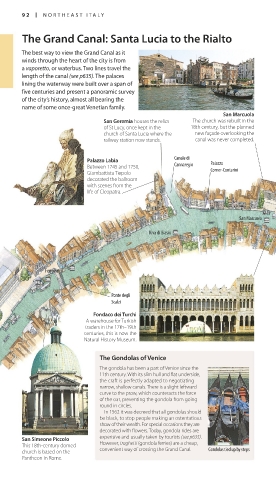
The Grand Canal: Santa Lucia to the Rialto
The best way to view the Grand Canal as it
winds through the heart of the city is from
a vaporetto, or waterbus. Two lines travel the
length of the canal (see p635). The palaces
lining the waterway were built over a span of
five centuries and present a panor amic survey
of the city’s history, almost all bearing the
name of some once-great Venetian family.
San Marcuola
San Geremia houses the relics The church was rebuilt in the
of St Lucy, once kept in the 18th century, but the planned
church of Santa Lucia where the new façade overlooking the
railway station now stands. canal was never completed.
Palazzo Labia Canale di Palazzo
Between 1745 and 1750, Cannaregio Corner-Contarini
Giambattista Tiepolo
decorated the ball room
with scenes from the
life of Cleopatra.
San Marcuola
Riva di Biasio
Ferrovia
Ponte degli
Scalzi
Fondaco dei Turchi
A warehouse for Turkish
traders in the 17th–19th
centuries, this is now the
Natural History Museum.
The Gondolas of Venice
The gondola has been a part of Venice since the
11th century. With its slim hull and flat underside,
the craft is perfectly adapted to negotiating
narrow, shallow canals. There is a slight leftward
curve to the prow, which counteracts the force
of the oar, preventing the gondola from going
round in circles.
In 1562 it was decreed that all gondolas should
be black, to stop people making an ostentatious
show of their wealth. For special occasions they are
decorated with flowers. Today, gondola rides are
San Simeone Piccolo expensive and usually taken by tourists (see p635).
This 18th-century domed However, traghetti (gondola ferries) are a cheap,
church is based on the convenient way of crossing the Grand Canal. Gondolas tied up by steps
Pantheon in Rome.
092-093_EW_Italy.indd 92 4/4/17 5:32 PM

