


Page 82 - Healthy (March - April 2020)
P. 82
IN         SEASON…


                    cauliflower


                                                                  The days of dodging mushy florets in
                                                           soggy school dinners are long gone – now
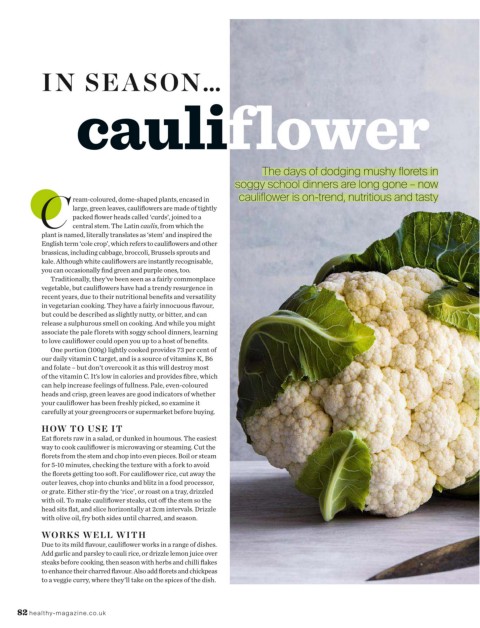
                   ream-coloured, dome-shaped plants, encased in   cauliflower is on-trend, nutritious and tasty
                   large, green leaves, caulilowers are made of tightly
                   packed lower heads called ‘curds’, joined to a
          C central stem. The Latin caulis, from which the
           plant is named, literally translates as ‘stem’ and inspired the
           English term ‘cole crop’, which refers to caulilowers and other
           brassicas, including cabbage, broccoli, Brussels sprouts and
           kale. Although white caulilowers are instantly recognisable,
           you can occasionally ind green and purple ones, too.
             Traditionally, they’ve been seen as a fairly commonplace
           vegetable, but caulilowers have had a trendy resurgence in
           recent years, due to their nutritional beneits and versatility
           in vegetarian cooking. They have a fairly innocuous lavour,
           but could be described as slightly nutty, or bitter, and can
           release a sulphurous smell on cooking. And while you might
           associate the pale florets with soggy school dinners, learning
           to love caulilower could open you up to a host of beneits.
             One portion (100g) lightly cooked provides 73 per cent of
           our daily vitamin C target, and is a source of vitamins K, B6
           and folate – but don’t overcook it as this will destroy most
           of the vitamin C. It’s low in calories and provides ibre, which
           can help increase feelings of fullness. Pale, even-coloured
           heads and crisp, green leaves are good indicators of whether
           your caulilower has been freshly picked, so examine it
           carefully at your greengrocers or supermarket before buying.

           HOW    TO   USE T
                             I
           Eat lorets raw in a salad, or dunked in houmous. The easiest
           way to cook caulilower is microwaving or steaming. Cut the
           lorets from the stem and chop into even pieces. Boil or steam
           for 5-10 minutes, checking the texture with a fork to avoid
           the lorets getting too soft. For caulilower rice, cut away the
           outer leaves, chop into chunks and blitz in a food processor,
           or grate. Either stir-fry the ‘rice’, or roast on a tray, drizzled
           with oil. To make caulilower steaks, cut of the stem so the
           head sits lat, and slice horizontally at 2cm intervals. Drizzle
           with olive oil, fry both sides until charred, and season.
           WORKS     WELL     WITH
           Due to its mild lavour, caulilower works in a range of dishes.
           Add garlic and parsley to cauli rice, or drizzle lemon juice over
           steaks before cooking, then season with herbs and chilli lakes
           to enhance their charred lavour. Also add lorets and chickpeas
           to a veggie curry, where they’ll take on the spices of the dish.


     82 healthy-magazine.co.uk

