


Page 61 - (DK Eyewitness) Travel Guide - Mallorca, Menorca & Ibiza
P. 61
P ALM A 59
around a large courtyard, adjoins
the city walls. Its façade was
completed in 1616.
Several rooms of the palace
have been given over to the
charming Museu Diocesà
(Diocese Museum). The
museum displays items from
various churches in Mallorca,
including a wonderful selection
of medieval religious paintings.
Particularly noteworthy are: a
picture of St George slaying
the dragon in front of Palma’s
Monastery courtyard of Basilica de Sant Francesc city gate, painted in 1468–70
by Pere Nisart; Bishop Galiana’s
R Basilíca de Sant Francesc P Banys Àrabs panel depicting the life of
Plaça Sant Francesc. Open 9:30am– Carrer Can Serra 7. Tel 637 046 534. St Paul (who is portrayed
12:30pm & 3:10–6pm Mon–Sat, Open 9am–7:30pm daily (to 6pm holding a sword) and the
9am–12:30pm Sun. & Dec–Mar). & Gothic pulpit in a Mudéjar
The building of the Gothic The brick 10thcentury hammam (SpanishMoorish) style. There
church and Franciscan mon (bathhouse) is one of the few is also the jasper sarcophagus
astery started in 1281 and architectural reminders of a of Jaume II, which stood in the
lasted 100 years. During the Moorish presence on cathedral until 1904.
Middle Ages, this was Palma’s the islands. A small
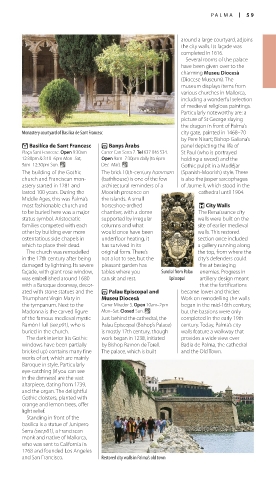
most fashionable church and horseshoearched + City Walls
to be buried here was a major chamber, with a dome The Renaissance city
status symbol. Aristocratic supported by irregular walls were built on the
families competed with each columns and what site of earlier medieval
other by building ever more would once have been walls. This restored
ostentatious side chapels in underfloor heating, it section once included
which to place their dead. has survived in its a gallery running along
The church was remodelled original form. There’s the top, from where the
in the 17th century after being not a lot to see, but the city’s defenders could
damaged by lightning. Its severe pleasant garden has fire at besieging
façade, with giant rose window, tables where you Sundial from Palau enemies. Progress in
was embellished around 1680 can sit and rest. Episcopal artillery design meant
with a Baroque doorway, decor that the fortifications
ated with stone statues and the P Palau Episcopal and became lower and thicker.
Triumphant Virgin Mary in Museu Diocesà Work on remodelling the walls
the tympanum. Next to the Carrer Mirador 5. Open 10am–2pm began in the mid16th century,
Madonna is the carved figure Mon–Sat. Closed Sun. & but the bastions were only
of the famous medieval mystic Just behind the cathedral, the completed in the early 19th
Ramón Llull (see p91), who is Palau Episcopal (Bishop’s Palace) century. Today, Palma’s city
buried in the church. is mostly 17th century, though walls feature a walkway that
The dark interior (its Gothic work began in 1238, initiated provides a wide view over
windows have been partially by Bishop Ramon de Torell. Badia de Palma, the cathedral
bricked up) contains many fine The palace, which is built and the Old Town.
works of art, which are mainly
Baroque in style. Particularly
eyecatching (if you can see
in the dimness) are the vast
altarpiece, dating from 1739,
and the organ. The delightful
Gothic cloisters, planted with
orange and lemon trees, offer
light relief.
Standing in front of the
basilica is a statue of Junipero
Serra (see p81), a Franciscan
monk and native of Mallorca,
who was sent to California in
1768 and founded Los Angeles
and San Francisco. Restored city walls in Palma’s old town
058-059_EW_Mallorca.indd 59 06/10/17 11:08 am

