


Page 121 - (DK Eyewitness) Travel Guide - England's South Coast
P. 121
DORSE T AND SOMERSE T 119
for women. It quickly became
one of the wealthiest and most
powerful abbeys in the south, but
was dissolved under Henry VIII
in 1539. Much of the surrounding
town fell into disrepair during the
years that followed. Little remains
of the fortifications, 12 churches
and four market crosses that
once made this a town of some
importance, although the 14th-
century St Peter’s Church is
one survivor.
Aerial view of the impressive prehistoric Maiden Castle The foundations of the abbey
now form part of the Abbey
series of wooden fences and (180-ft-) high carving to be a Museum and Garden, which
staggered gates that would fertility figure representing either explores the abbey’s fascinating
have made the hilltop nigh-on the Roman god Hercules or an history, including details of King
impregnable to invading forces – Iron Age warrior, though others Cnut’s death here in 1035. The
at least until AD 43, when the argue he may be a much later king was believed to have been
Romans defeated the tribe in caricature of Oliver Cromwell. The visiting the tomb of the Saxon
a bloody battle. Despite their figure has now been fenced off king Edward the Martyr, who
victory the Romans decided to avoid erosion and is best seen was buried in the abbey after
to settle in nearby Dorchester, from the well-signed viewpoint his murder at Corfe Castle
building a temple on the hilltop on the hillside opposite, or via (see p114) in 978.
in the 4th century that was later the Giant’s Walk, a marked 90- Today, Shaftesbury’s cobbled
abandoned; the foundations minute trail from the village. streets and pretty 18th-century
survive today on a grassy hillock. cottages are often used as a
Visitors can walk up the slopes to setting in films to give a flavour
the top of Maiden Castle, now u Shaftesbury of English rural history. Its most
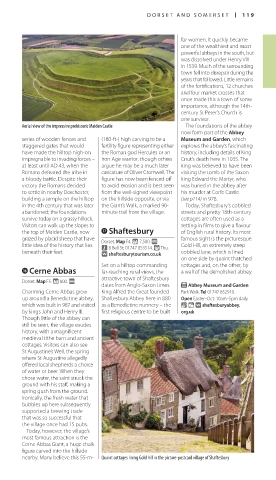
grazed by placid sheep that have Dorset. Map F4. * 7,500. @ famous sight is the picturesque
little idea of the history that lies n 8 Bell St; 01747 853514. ( Thu. Gold Hill, an extremely steep
beneath their feet. ∑ shaftesburytourism.co.uk cobbled lane, which is lined
on one side by quaint thatched
Set on a hilltop commanding cottages and, on the other, by
y Cerne Abbas far-reaching rural views, the a wall of the demolished abbey.
attractive town of Shaftesbury
Dorset. Map F5. * 800. @
dates from Anglo-Saxon times. E Abbey Museum and Garden
Charming Cerne Abbas grew King Alfred the Great founded Park Walk. Tel 01747 852910.
up around a Benedictine abbey, Shaftesbury Abbey here in 880 Open Easter–Oct: 10am–5pm daily.
which was built in 987 and visited as a Benedictine nunnery – the & = ∑ shaftesburyabbey.
by kings John and Henry III. first religious centre to be built org.uk
Though little of the abbey can
still be seen, the village exudes
history, with a magnificent
medieval tithe barn and ancient
cottages. Visitors can also see
St Augustine’s Well, the spring
where St Augustine allegedly
offered local shepherds a choice
of water or beer. When they
chose water, the saint struck the
ground with his staff, making a
spring gush from the ground.
Ironically, the fresh water that
bubbles up here subsequently
supported a brewing trade
that was so successful that
the village once had 15 pubs.
Today, however, the village’s
most famous attraction is the
Cerne Abbas Giant, a huge chalk
figure carved into the hillside
nearby. Many believe this 55-m- Quaint cottages lining Gold Hill in the picture-postcard village of Shaftesbury
118-119_EW_ESC.indd 119 10/03/17 6:53 pm

