


Page 80 - (DK Eyewitness) Travel Guide - England's South Coast
P. 80
78 ENGLAND ’ S SOUTH C O AST REGION B Y REGION
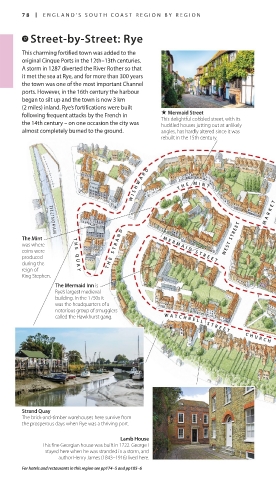
u Street-by-Street: Rye
This charming fortified town was added to the
original Cinque Ports in the 12th–13th centuries.
A storm in 1287 diverted the River Rother so that
it met the sea at Rye, and for more than 300 years
the town was one of the most important Channel
ports. However, in the 16th century the harbour
began to silt up and the town is now 3 km
(2 miles) inland. Rye’s fortifications were built
following frequent attacks by the French in . Mermaid Street
This delightful cobbled street, with its
the 14th century – on one occasion the city was huddled houses jutting out at unlikely
almost completely burned to the ground. angles, has hardly altered since it was
rebuilt in the 15th century.
R D D
A A
W O
H T H E M I N T R
S
I
W T
E
K
R
A M
D
N
TILLINGHAM
The Mint T A W E S T S T R E E T
was where H R T
coins were E S T M E R M A I D S T R E E T E E
produced Q E R
during the A H S T
U
reign of Y T N
King Stephen. O
I
The Mermaid Inn is L
Rye’s largest medieval M A R K E T S T R E E T
building. In the 1750s it
was the headquarters of a
notorious group of smugglers
called the Hawkhurst gang. W A T C H B E L L S T R E E T C H U R C H S Q U A R E
Strand Quay
The brick-and-timber warehouses here survive from
the prosperous days when Rye was a thriving port.
Lamb House
This fine Georgian house was built in 1722. George I
stayed here when he was stranded in a storm, and
author Henry James (1843–1916) lived here.
For hotels and restaurants in this region see pp174–5 and pp185–6
078-079_EW_ESC.indd 78 10/03/17 6:52 pm

