


Page 240 - (DK Eyewitness) Travel Guide - Sicily
P. 240
238 SUR VIV AL GUIDE
Getting Around Sicily
The heart of the largest island in the Mediterranean is rugged
and mountainous and the roads become steep and winding.
Visitors should note that what may look like a short journey
on the map may in fact take quite a long time. The bus
network connects most towns and villages. Sicily’s rail
network includes a full circuit of Mount Etna, a journey that
takes around 5 hours. The trains are generally slow and
unreliable (except those in the main provincial capitals).
A car is usually needed to reach the more rural areas.
Green Travel
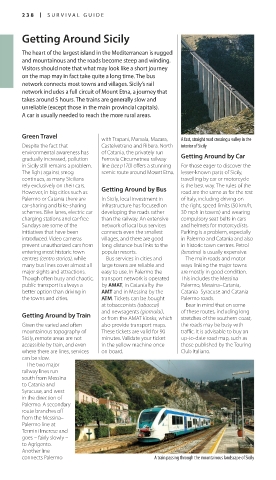
with Trapani, Marsala, Mazara, A fast, straight road crossing a valley in the
Despite the fact that Castelvetrano and Ribera. North interior of Sicily
environmental awareness has of Catania, the privately run Getting Around by Car
gradually increased, pollution Ferrovia Circumetnea railway
in Sicily still remains a problem. line (see p170) offers a stunning For those eager to discover the
The fight against smog scenic route around Mount Etna. lesser-known parts of Sicily,
continues, as many Sicilians travelling by car or motor cycle
rely exclu sively on their cars. is the best way. The rules of the
However, in big cities such as Getting Around by Bus road are the same as for the rest
Palermo or Catania there are In Sicily, local investment in of Italy, including driving on
car-sharing and bike-sharing infrastruc ture has focused on the right, speed limits (50 km/h,
schemes. Bike lanes, electric car develop ing the roads rather 30 mph in towns) and wearing
charging stations and car-free than the railway. An extensive com pul sory seat belts in cars
Sundays are some of the network of local bus services and helmets for motorcyclists.
initiatives that have been connects even the smallest Park ing is a problem, especially
introduced. Video cameras villages, and there are good in Palermo and Catania and also
prevent unauthorized cars from long-distance bus links to the in historic town centres. Petrol
entering most hist oric town popular resorts. (benzina) is usually expensive.
centres (centro storico), while Bus services in cities and The main roads and motor-
many bus lines cover almost all large towns are reliable and ways linking the major towns
major sights and attractions. easy to use. In Palermo the are mostly in good condition.
Though often busy and chaotic, transport network is operated This includes the Messina–
public transpor t is always a by AMAT, in Catania by the Palermo, Messina–Catania,
better option than driving in AMT and in Messina by the Catania–Syracuse and Catania–
the towns and cities. ATM. Tickets can be bought Palermo roads.
at tobacconists (tabaccai) Bear in mind that on some
and newsagents (giornalai), of these routes, including long
Getting Around by Train or from the AMAT kiosks, which stretches of the southern coast,
Given the varied and often also provide transport maps. the roads may be busy with
mountainous topography of These tickets are valid for 90 traffic. It is advisable to buy an
Sicily, remote areas are not minutes. Validate your ticket up-to-date road map, such as
accessible by train, and even in the yellow machine once those published by the Touring
where there are lines, services on board. Club Italiano.
can be slow.
The two major
railway lines run
south from Messina
to Catania and
Syracuse, and west
in the direction of
Palermo. A secondary
route branches off
from the Messina–
Palermo line at
Termini Imerese and
goes – fairly slowly –
to Agrigento.
Another line
connects Palermo A train passing through the mountainous landscape of Sicily
238-239_EW_Sicily.indd 238 11/3/16 2:07 PM

