


Page 186 - (DK Eyewitness) Travel Guide - Europe
P. 186
184 FR ANCE AND THE L OW C OUNTRIES
o Street by Street: Dijon
The center of Dijon is noted for its architectural
splendor – a legacy from the dukes of Burgundy
(see p182). Wealthy parliament members also had
elegant hôtels particuliers (private mansions) built
in the 17th and 18th centuries. The capital of
Burgundy, Dijon today has a rich cultural life
and a renowned university. The city’s great art
treasures are housed in the Palais des Ducs.
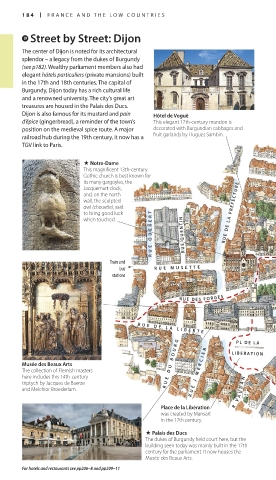
Dijon is also famous for its mustard and pain Hôtel de Voguë
d’épice (gingerbread), a reminder of the town’s This elegant 17th-century mansion is
position on the medieval spice route. A major decorated with Burgundian cabbages and
railroad hub during the 19th century, it now has a fruit garlands by Hugues Sambin.
TGV link to Paris.
. Notre-Dame
This magnificent 13th-century
Gothic church is best known for
its many gargoyles, the
Jacquemart clock, E
and, on the north R I
wall, the sculpted E
owl (chouette), said R
to bring good luck R U E D E L A P R E F E C T U R E R
RUE ODEBERT R U E Q U E N T I N U E V
when touched. E
Train and R
bus R U E M U S E T T E
stations
R U E D E S F O R G E S
R U E D E L A L I B E R T E
G P L D E L A
R
U R
O E L I B E R A T I O N
B C I
Musée des Beaux Arts U R
The collection of Flemish masters D M E
here includes this 14th-century E N
triptych by Jacques de Baerze U J A
and Melchior Broederlam. R U E U B
R A
V
Place de la Libération R
was created by Mansart
in the 17th century.
. Palais des Ducs
The dukes of Burgundy held court here, but the
building seen today was mainly built in the 17th
century for the parliament. It now houses the
Musée des Beaux Arts.
For hotels and restaurants see pp206–8 and pp209–11
184-185_EW_Europe.indd 184 14/07/16 10:09 am

