


Page 372 - (DK Eyewitness) Travel Guide - Europe
P. 372
370 IT AL Y AND GREECE
fought to decide which of them
should be in charge of their
nebulous empire.
Meanwhile, a succession of foreign
invaders – Normans, Angevins, and
Aragonese – conquered Sicily and
the south. The north, in contrast,
saw a growth of independent city
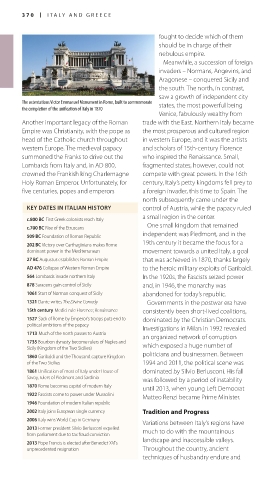
The ostentatious Victor Emmanuel Monument in Rome, built to commemorate states, the most powerful being
the completion of the unification of Italy in 1870
Venice, fabulously wealthy from
Another important legacy of the Roman trade with the East. Northern Italy became
Empire was Christianity, with the pope as the most prosperous and cultured region
head of the Catholic church throughout in western Europe, and it was the artists
western Europe. The medieval papacy and scholars of 15th-century Florence
summoned the Franks to drive out the who inspired the Renaissance. Small,
Lombards from Italy and, in AD 800, fragmented states, however, could not
crowned the Frankish king Charlemagne compete with great powers. In the 16th
Holy Roman Emperor. Unfortunately, for century, Italy’s petty kingdoms fell prey to
five centuries, popes and emperors a foreign invader, this time to Spain. The
north subsequently came under the
KEY DATES IN ITALIAN HISTORY control of Austria, while the papacy ruled
a small region in the center.
c.800 BC First Greek colonists reach Italy
c.700 BC Rise of the Etruscans One small kingdom that remained
509 BC Foundation of Roman Republic independent was Piedmont, and in the
202 BC Victory over Carthaginians makes Rome 19th century it became the focus for a
dominant power in the Mediterranean movement towards a united Italy, a goal
27 BC Augustus establishes Roman Empire that was achieved in 1870, thanks largely
AD 476 Collapse of Western Roman Empire to the heroic military exploits of Garibaldi.
564 Lombards invade northern Italy In the 1920s, the Fascists seized power
878 Saracens gain control of Sicily and, in 1946, the monarchy was
1061 Start of Norman conquest of Sicily abandoned for today’s republic.
1321 Dante writes The Divine Comedy Governments in the postwar era have
15th century Medici rule Florence; Renaissance consistently been short-lived coalitions,
1527 Sack of Rome by Emperor’s troops puts end to dominated by the Christian Democrats.
political ambitions of the papacy
Investigations in Milan in 1992 revealed
1713 Much of the north passes to Austria an organized network of corruption
1735 Bourbon dynasty become rulers of Naples and
Sicily (Kingdom of the Two Sicilies) which exposed a huge number of
1860 Garibaldi and the Thousand capture Kingdom politicians and businessmen. Between
of the Two Sicilies 1994 and 2011, the political scene was
1861 Unification of most of Italy under House of dominated by Silvio Berlusconi. His fall
Savoy, rulers of Piedmont and Sardinia was followed by a period of instability
1870 Rome becomes capital of modern Italy until 2013, when young Left Democrat
1922 Fascists come to power under Mussolini
Matteo Renzi became Prime Minister.
1946 Foundation of modern Italian republic
2002 Italy joins European single currency Tradition and Progress
2006 Italy wins World Cup in Germany Variations between Italy’s regions have
2013 Former president Silvio Berlusconi expelled much to do with the mountainous
from parliament due to tax fraud conviction
2013 Pope Francis is elected after Benedict XVI’s landscape and inaccessible valleys.
unprecedented resignation Throughout the country, ancient
techniques of husbandry endure and
370-371_EW_Europe.indd 370 14/07/16 10:10 am

