


Page 382 - (DK Eyewitness) Travel Guide - Europe
P. 382
380 IT AL Y AND GREECE
Exploring the side walls, painted between
Vatican’s Collections 1481 and 1483. Their subjects
are parallel episodes in the lives
of Moses and Christ.
The Vatican’s greatest treasures are its Greek and Roman In 1508–12, at the request
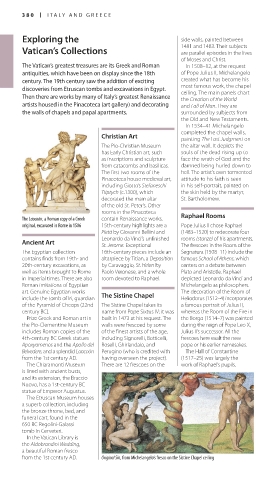
antiquities, which have been on display since the 18th of Pope Julius II, Michelangelo
century. The 19th century saw the addition of exciting created what has become his
discoveries from Etruscan tombs and excavations in Egypt. most famous work, the chapel
ceiling. The main panels chart
Then there are works by many of Italy’s greatest Renaissance the Creation of the World
artists housed in the Pinacoteca (art gallery) and decorating and Fall of Man. They are
the walls of chapels and papal apartments. surrounded by subjects from
the Old and New Testaments.
In 1534–41 Michelangelo
completed the chapel walls,
Christian Art painting The Last Judgment on
The Pio-Christian Museum the altar wall. It depicts the
has Early Christian art, such souls of the dead rising up to
as inscriptions and sculpture face the wrath of God and the
from catacombs and basilicas. damned being hurled down to
The first two rooms of the hell. The artist’s own tormented
Pinacoteca house medieval art, attitude to his faith is seen
including Giotto’s Stefaneschi in his self-portrait, painted on
Triptych (c.1300), which the skin held by the martyr,
decorated the main altar St. Bartholomew.
of the old St. Peter’s. Other
rooms in the Pinacoteca
The Laocoön, a Roman copy of a Greek contain Renaissance works. Raphael Rooms
original, excavated in Rome in 1506 15th-century highlights are a Pope Julius II chose Raphael
Pietà by Giovanni Bellini and (1483–1520) to redecorate four
Leonardo da Vinci’s unfinished rooms (stanze) of his apartments.
Ancient Art
St. Jerome. Exceptional The frescoes in the Room of the
The Egyptian collection 16th-century pieces include an Segnatura (1508–11) include the
contains finds from 19th- and altarpiece by Titian, a Deposition famous School of Athens, which
20th-century excavations, as by Caravaggio, St. Helen by centers on a debate between
well as items brought to Rome Paolo Veronese, and a whole Plato and Aristotle. Raphael
in Imperial times. There are also room devoted to Raphael. depicted Leonardo da Vinci and
Roman imitations of Egyptian Michelangelo as philosophers.
art. Genuine Egyptian works The decoration of the Room of
include the tomb of Iri, guardian The Sistine Chapel Heliodorus (1512–4) incorporates
of the Pyramid of Cheops (22nd The Sistine Chapel takes its a famous portrait of Julius II,
century BC). name from Pope Sixtus IV; it was whereas the Room of the Fire in
Prize Greek and Roman art in built in 1473 at his request. The the Borgo (1514–7) was painted
the Pio-Clementine Museum walls were frescoed by some during the reign of Pope Leo X,
includes Roman copies of the of the finest artists of the age, Julius II’s successor. All the
4th-century BC Greek statues including Signorelli, Botticelli, frescoes here exalt the new
Apoxyomenos and the Apollo del Roselli, Ghirlandaio, and pope or his earlier namesakes.
Belvedere, and a splendid Laocoön Perugino (who is credited with The Hall of Constantine
from the 1st century AD. having overseen the project). (1517–25) was largely the
The Chiaramonti Museum There are 12 frescoes on the work of Raphael’s pupils.
is lined with ancient busts,
and its extension, the Braccio
Nuovo, has a 1st-century BC
statue of Emperor Augustus.
The Etruscan Museum houses
a superb collection, including
the bronze throne, bed, and
funeral cart, found in the
650 BC Regolini-Galassi
tomb in Cerveteri.
In the Vatican Library is
the Aldobrandini Wedding,
a beautiful Roman fresco
from the 1st century AD. Original Sin, from Michelangelo’s fresco on the Sistine Chapel ceiling
380-381_EW_Europe.indd 380 14/07/16 10:16 am

