


Page 448 - (DK Eyewitness) Travel Guide - Europe
P. 448
446 IT AL Y AND GREECE
province of Rome. As part of the Eastern
Roman Empire, it was ruled from
Constantinople and became a powerful
element within the Orthodox Christian,
Byzantine world.
Following the Ottomans’ momentous
capture of Constantinople in 1453, the
Greek mainland was ruled by the Turks
for the next 375 years. Crete and the
Ionian islands were seized for long periods
by the Venetians. Eventually, the Greeks
rebelled and, in 1821, the Greek War
of Independence began. In 1832, the
Great Powers that dominated Europe
established a protectorate over Greece,
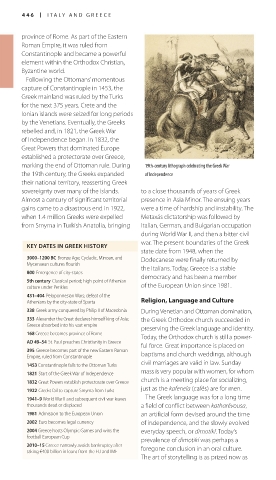
marking the end of Ottoman rule. During 19th-century lithograph celebrating the Greek War
the 19th century, the Greeks expanded of Independence
their national territory, reasserting Greek
sovereignty over many of the islands. to a close thousands of years of Greek
Almost a century of significant territorial presence in Asia Minor. The ensuing years
gains came to a disastrous end in 1922, were a time of hardship and instability. The
when 1.4 million Greeks were expelled Metaxás dictatorship was followed by
from Smyrna in Turkish Anatolia, bringing Italian, German, and Bulgarian occupation
during World War II, and then a bitter civil
war. The present boundaries of the Greek
KEY DATES IN GREEK HISTORY
state date from 1948, when the
3000–1200 BC Bronze Age; Cycladic, Minoan, and Dodecanese were finally returned by
Mycenaean cultures flourish
the Italians. Today, Greece is a stable
800 Emergence of city-states
5th century Classical period; high point of Athenian democracy and has been a member
culture under Perikles of the European Union since 1981.
431–404 Peloponnesian Wars; defeat of the
Athenians by the city-state of Sparta Religion, Language and Culture
338 Greek army conquered by Philip II of Macedonia During Venetian and Ottoman domination,
333 Alexander the Great declares himself king of Asia; the Greek Orthodox church succeeded in
Greece absorbed into his vast empire preserving the Greek language and identity.
168 Greece becomes province of Rome
Today, the Orthodox church is still a power-
AD 49–54 St. Paul preaches Christianity in Greece ful force. Great importance is placed on
395 Greece becomes part of the new Eastern Roman
Empire, ruled from Constantinople baptisms and church weddings, although
1453 Constantinople falls to the Ottoman Turks civil marriages are valid in law. Sunday
1821 Start of the Greek War of Independence mass is very popular with women, for whom
1832 Great Powers establish protectorate over Greece church is a meeting place for socializing,
1922 Greeks fail to capture Smyrna from Turks just as the kafeneía (cafés) are for men.
1941–9 World War II and subsequent civil war leaves The Greek language was for a long time
thousands dead or displaced a field of conflict between katharévousa,
1981 Admission to the European Union an artificial form devised around the time
2002 Euro becomes legal currency of independence, and the slowly evolved
2004 Greece hosts Olympic Games and wins the everyday speech, or dimotikí. Today’s
football European Cup prevalence of dimotikí was perhaps a
2010–15 Greece narrowly avoids bankruptcy after foregone conclusion in an oral culture.
taking €400 billion in loans from the EU and IMF
The art of storytelling is as prized now as
444-447_EW_Europe.indd 446 14/07/16 10:17 am

