


Page 48 - (DK Eyewitness) Travel Guide - Europe
P. 48
46 BRIT AIN AND IRELAND
royal lineage which still rules the country English sailors ranged far across the
today. The disparate cultures of the world. The total defeat of the Spanish
Normans and Anglo-Saxons combined Armada in 1588 confirmed Britain’s
to form the English nation, a process position as a major maritime power.
nurtured by Britain’s position as an island. The Stuart period saw the English and
Scotland’s four divided kingdoms had Scottish crowns unite, but internal
also unified under one monarch struggles eventually led to the
by this time, with the crowning Civil War in 1642. By the time of
of Duncan I in 1034. the Act of Union with Scotland
The next 400 years saw English in 1707, however, the whole
kings extend their domain at island was united and the
home as well as abroad. Wales foundations for representative
was conquered in 1282, and by government had been laid. The
1296 control was also gained over combination of internal security
Scotland. The Scots rose up and maritime strength allowed
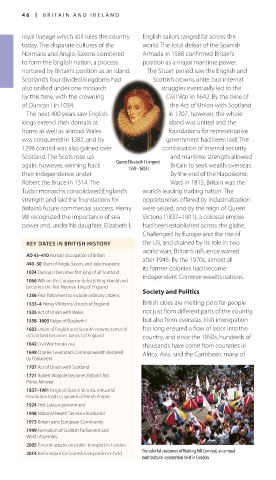
again, however, winning back Queen Elizabeth I (reigned Britain to seek wealth overseas.
1558–1603)
their independence under By the end of the Napoleonic
Robert the Bruce in 1314. The Wars in 1815, Britain was the
Tudor monarchs consolidated England’s world’s leading trading nation. The
strength and laid the foundations for opportunities offered by industrialization
Britain’s future commercial success. Henry were seized, and by the reign of Queen
VIII recognized the importance of sea Victoria (1837–1901), a colossal empire
power and, under his daughter, Elizabeth I, had been established across the globe.
Challenged by Europe and the rise of
KEY DATES IN BRITISH HISTORY the US, and drained by its role in two
world wars, Britain’s influence waned
AD 43–410 Roman occupation of Britain
440–50 Start of Angle, Saxon, and Jute invasions after 1945. By the 1970s, almost all
1034 Duncan I becomes first king of all Scotland its former colonies had become
1066 William the Conqueror defeats King Harold and independent Commonwealth nations.
becomes the first Norman king of England
1256 First Parliament to include ordinary citizens Society and Politics
1533–4 Henry VIII forms Church of England British cities are melting-pots for people
1535 Act of Union with Wales not just from different parts of the country,
1558–1603 Reign of Elizabeth I but also from overseas. Irish immigration
1603 Union of English and Scottish crowns; James VI has long ensured a flow of labor into the
of Scotland becomes James I of England country, and since the 1950s, hundreds of
1642 Civil War breaks out thousands have come from countries in
1649 Charles I executed. Commonwealth declared Africa, Asia, and the Caribbean, many of
by Parliament
1707 Act of Union with Scotland
1721 Robert Walpole becomes Britain’s first
Prime Minister
1837–1901 Reign of Queen Victoria. Industrial
Revolution leads to growth of British Empire
1924 First Labour government
1948 National Health Service introduced
1973 Britain joins European Community
1999 Formation of Scottish Parliament and
Welsh Assembly
2005 Terrorist attacks on public transport in London
2014 Referendum for Scottish Independence held The colorful costumes of Notting Hill Carnival, an annual
multicultural celebration held in London
044-047_EW_Europe.indd 46 14/07/16 10:12 am

