


Page 538 - (DK Eyewitness) Travel Guide - Europe
P. 538
536 GERM AN Y , A USTRIA , AND SWITZERLAND
Northern Germany Chagall, Picasso, and Christo.
Also worth visiting is the
Three federal states – Lower Saxony and the city-states of Niedersächsisches
Hamburg and Bremen – occupy a huge swathe of northern Landesmuseum, whose picture
Germany. Lower Saxony’s capital, Hanover, has splendid gallery has German medieval
architecture and fine museums. Hamburg and Bremen were and Renaissance paintings,
Dutch and Flemish works
wealthy Hanseatic trading towns, and today their ports still play by Rubens, Rembrandt, and
an important role in city life. The region’s other main attractions van Dyck, and 19th- and
are the well- preserved medieval towns of Münster, in North 20th-century German art.
Rhine-Westphalia, and Lübeck in Schleswig-Holstein. West of the city center, the
Herrenhäuser Gärten are
among the most beautiful
j Hanover Baroque gardens in Germany.
* 519,000. £ n Ernst-August-Platz
8 (0511-12 34 51 11). _ Schützenfest E Sprengel Museum
(Jun–Jul). ∑ hannover.de Kurt-Schwitters-Platz. Tel 0511-16
84 38 75. Open Tue–Sun. &
Hanover (Hannover) is the E Niedersächsisches
capital of Lower Saxony, and for Landesmuseum
more than a century, from 1714 Willy-Brandt-Allee 5. Tel 0511-980
to 1837, shared a succession 7686. Open Tue–Sun.
of rulers with Britain. Heavily
bombed during World War II, k Bremen
the city has been largely rebuilt.
Among the city’s finest * 556,000. g £ n Am
landmarks are the grand Bahnhofplatz 15 (0421-308 000).
Opernhaus (Opera House), ∑ bremen-tourism.de
built in Neoclassical style in
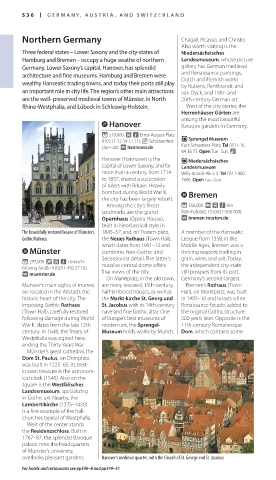
The beautifully restored facade of Münster’s 1845–57, and, on Tramm-platz, A member of the Hanseatic
Gothic Rathaus the Neues Rathaus (Town Hall), League from 1358, in the
which dates from 1901–13 and Middle Ages, Bremen was a
h Münster combines Neo-Gothic and thriving seaport, trading in
Secessionist detail. The latter’s grain, wine, and salt. Today,
* 297,000. k £ n Heinrich-
Brüning-Straße 9 (0251-492 27 10). massive central dome offers the independent city-state
∑ muenster.de fine views of the city. still prospers from its port,
On Marktplatz, in the old town, Germany’s second-largest.
Münster’s main sights of interest are many restored, 15th-century, Bremen’s Rathaus (Town
are located in the Altstadt, the half-timbered houses, as well as Hall), on Marktplatz, was built
historic heart of the city. The the Markt-kirche St. Georg und in 1405–10 and boasts a fine
imposing Gothic Rathaus St. Jacobus with its 14th-century Renaissance facade, added to
(Town Hall), carefully restored nave and fine Gothic altar. One the original Gothic structure
following damage during World of Europe’s best museums of 200 years later. Opposite is the
War II, dates from the late 12th modern art, the Sprengel- 11th-century Romanesque
century. In 1648, the Treaty of Museum holds works by Munch, Dom, which contains some
Westphalia was signed here,
ending the Thirty Years’ War.
Münster’s great cathedral, the
Dom St. Paulus, on Domplatz,
was built in 1225–65. Its best-
known treasure is the astro nom-
i cal clock (1540). Also on the
square is the Westfälisches
Landesmuseum, specializing
in Gothic art. Nearby, the
Lambertikirche (1375–1450)
is a fine example of the hall-
churches typical of Westphalia.
West of the center stands
the Residenzschloss. Built in
1767–87, the splendid Baroque
palace, now the headquarters
of Münster’s university,
overlooks pleasant gardens. Hanover’s medieval quarter, with the Church of St. George and St. Jacobus
For hotels and restaurants see pp546–8 and pp549–51
536-537_EW_Europe.indd 536 14/07/16 10:18 am

