


Page 567 - (DK Eyewitness) Travel Guide - Europe
P. 567
VIENNA 565
architecture is complemented
by the extensive formal gardens,
with their neat lawns and
careful planting. An array of
fountains and statues is framed
by trees and alleyways. The
gardens also contain a huge
tropical Palm House with an
interesting collection of exotic
plants, a small zoo, a butterfly
house, an orangery, and the
Gloriette – a large Neoclassical
arcade which crowns the hill
behind the palace.
Inside the palace, the Rococo
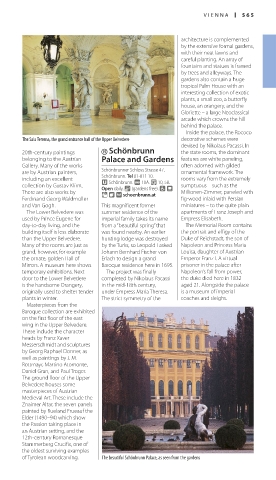
The Sala Terrena, the grand entrance hall of the Upper Belvedere decorative schemes were
devised by Nikolaus Pacassi. In
20th-century paintings t Schönbrunn the state rooms, the dominant
belonging to the Austrian Palace and Gardens features are white paneling,
Gallery. Many of the works often adorned with gilded
are by Austrian painters, Schönbrunner Schloss Strasse 47, ornamental framework. The
including an excellent Schönbrunn. Tel 01-811 10. rooms vary from the extremely
Schönbrunn. @ 10A. v 10, 58.
collection by Gustav Klimt. Open daily. & (gardens free). 7 - sumptuous – such as the
There are also works by = 8 ∑ schoenbrunn.at Millionen-Zimmer, paneled with
Ferdinand Georg Waldmüller fig-wood inlaid with Persian
and Van Gogh. This magnificent former miniatures – to the quite plain
The Lower Belvedere was summer residence of the apartments of Franz Joseph and
used by Prince Eugene for imperial family takes its name Empress Elisabeth.
day-to-day living, and the from a “beautiful spring” that The Memorial Room contains
building itself is less elaborate was found nearby. An earlier the portrait and effigy of the
than the Upper Belvedere. hunting lodge was destroyed Duke of Reichstadt, the son of
Many of the rooms are just as by the Turks, so Leopold I asked Napoleon and Princess Maria
grand, however, for example Johann Bernhard Fischer von Louisa, daughter of Austrian
the ornate, golden Hall of Erlach to design a grand Emperor Franz I. A virtual
Mirrors. A museum here shows Baroque residence here in 1695. prisoner in the palace after
temporary exhibitions. Next The project was finally Napoleon’s fall from power,
door to the Lower Belvedere completed by Nikolaus Pacassi the duke died here in 1832
is the handsome Orangery, in the mid-18th century, aged 21. Alongside the palace
originally used to shelter tender under Empress Maria Theresa. is a museum of imperial
plants in winter. The strict symmetry of the coaches and sleighs.
Master pieces from the
Baroque collection are exhibited
on the first floor of the east
wing in the Upper Belvedere.
These include the character
heads by Franz Xaver
Messerschmidt and sculptures
by Georg Raphael Donner, as
well as paintings by J. M.
Rottmayr, Martino Atomonte,
Daniel Gran, and Paul Troger.
The ground floor of the Upper
Belvedere houses some
masterpieces of Austrian
Medieval Art. These include the
Znaimer Altar, the seven panels
painted by Rueland Frueauf the
Elder (1490–94) which show
the Passion taking place in
an Austrian setting, and the
12th-century Romanesque
Stammerberg Crucifix, one of
the oldest surviving examples
of Tyrolean woodcarving. The beautiful Schönbrunn Palace, as seen from the gardens
564-565_EW_Europe.indd 565 14/07/16 10:18 am

