


Page 579 - (DK Eyewitness) Travel Guide - Europe
P. 579
GERM AN Y , A USTRIA , AND SWITZERLAND 577
SWITZERLAND
The stereotypical images of Switzerland – cozy wooden chalets, alpine
meadows, and chic skiing resorts – are easy to find. But there are many other
sides to this small, diverse country that are equally accessible, from picturesque
medieval towns to world-class art and fine gastronomy. Switzerland’s rural
retreats offer wonderful opportunities for relaxing and recharging.
Switzerland lies at the very heart of rock, and with no seaboard and few
Europe, landlocked between the Alps and natural resources other than water power,
the Jura mountains. It is bordered to the the country has managed to preserve a
west by France, to the north by Germany, proud and united spirit of independence.
to the east by Austria and Liechtenstein,
and to the south by Italy. History
Mountains make up almost a third of Switzerland’s geography has presented
Switzerland’s 41,285 sq km (15,949 sq both opportunities and disadvantages.
miles). The St. Gotthard Massif is the Its story has been of a gradual coming
source of many lakes and two major rivers, together, not without bloodshed, of a
the Rhine and the Rhône. Central population of diverse cultures, religions,
Switzerland has the highest concentration and languages, making what is today
of picturesque Alpine peaks, although the viewed as a haven of peace and reason.
loftiest Alps are those of the Valais in the The Jura mountains provide the earliest
southwest. The valleys of Graubünden in evidence of Switzerland’s habitation,
the east provide the setting for many which dates to over 50,000 years ago.
winter resorts. In the west, the cities lining By the start of the Christian era, Celtic
the northern shore of Lake Geneva peoples were living in western Switzerland
comprise the “Swiss Riviera,” while a series and Germanic tribes in the north and
of high passes provides overland access east. Many of these communities were
from German-speaking Switzerland to the under the control of the expanding
Ticino, the Italian-speaking part of the Roman Empire, whose influence spread
country, and to Italy. after 58 BC.
With almost a quarter of its area The Germanic tribes to the north
comprising high Alps, lakes, and barren eventually broke through Roman
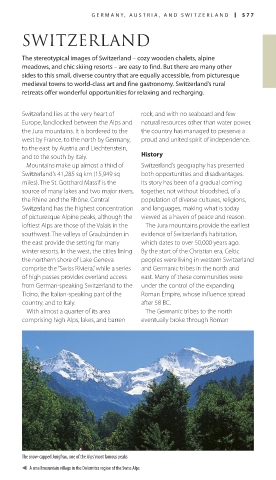
The snow-capped Jungfrau, one of the Alps’ most famous peaks
A small mountain village in the Dolomites region of the Swiss Alps
576-579_EW_Europe.indd 577 14/07/16 10:10 am

