


Page 693 - (DK Eyewitness) Travel Guide - Europe
P. 693
CENTR AL AND EASTERN EUROPE 691
HUNGARY
Uniquely in central Europe, Hungary is peopled by descendants of the Magyars,
a race from central Asia who settled here at the end of the 9th century. In more
recent times, the country has fought against Turkish, German, Austrian, and
Russian occupiers, yet its rich indigenous culture remains intact. In 1989, Hungary
became the first Soviet Bloc country to embrace Western-style democracy.
Hungary has an extremely varied was ruled by the Goths, the Longobards,
landscape, with forests and mountains and the Avars. The ancestors of the
dominating the north and a vast plain modern Hungarians, the Magyars,
covering the rest of the country. The Tisza migrated from the Urals in 896, under
river and its tributaries shape the eastern the leadership of Prince Árpád, whose
regions, while the west has Lake Balaton, dynasty ruled until 1301, when King
one of the largest lakes in Europe. The András III died without leaving an heir.
Danube flows through the heart of the The throne then passed to a series of
country, bisecting the capital, Budapest, foreign kings, including the French
where one-fifth of the population lives. Angevins and the Lithuanian Jagiellos,
Ethnically the country is 92 percent but the country flourished, and during
Magyar, 3 percent Roma, and the rest the reign of Mátyás Corvinus (1458–90), it
divided between Germans, Slovaks, became the greatest monarchy in Middle
Slovens, and others. About one percent Europe. Mátyás’s marriage to Beatrice, a
of the population is of Jewish origin. Neapolitan princess, saw the Renaissance
blossom throughout Hungary, but all was
History soon eclipsed by a series of Turkish
In AD 100, the Romans established the invasions. The Turks won a major victory at
town of Aquincum near modern-day the Battle of Mohács in 1526, then they
Budapest, and ruled the area corresponding returned in 1541 to take Buda, which
roughly to Hungary (then called Pannonia) became the capital of Ottoman Hungary.
for three centuries. The arrival of the Huns To quell the Turkish advance, the Austrians,
in the early 5th century led to the under Ferdinand of Habsburg, occupied
complete withdrawal of the Romans. After western (or “Royal”) Hungary, while the
the death of Attila the Hun in 453, the area central plains stayed under Ottoman
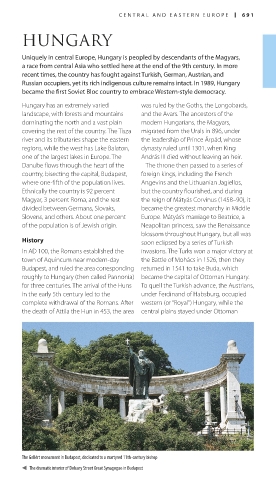
The Gellért monument in Budapest, dedicated to a martyred 11th-century bishop
The dramatic interior of Dohany Street Great Synagogue in Budapest
690-693_EW_Europe.indd 691 14/07/16 10:10 am

