


Page 63 - Car South Africa (February 2020)
P. 63
At 1 280 km/h,

                      the wheels generate

                           about 45 000 G


                  The wheels are 930 mm in
                diameter, weigh 100 kg each and
                are made from forged aluminium
                alloy. Tony talked me through
                their manufacturing process (at
                a cost of £200 000 each), followed
                by the careful balancing method
                of shaving off mere grams from
                these beautiful items.
                  At 1 280 km/h, these wheels will
                be doing about 8 000 r/min, gener-
                ating approximately 45 000 G. Just
                let that sink in...The three sets of
                wheel bearings were the very  rst
                parts to be speci ed.
                  The small windscreen changes
                the direction of the air ow at high
                speed. Tony explains: “When you
                go through the sound barrier, that  07
                shock wave is almost vertical.
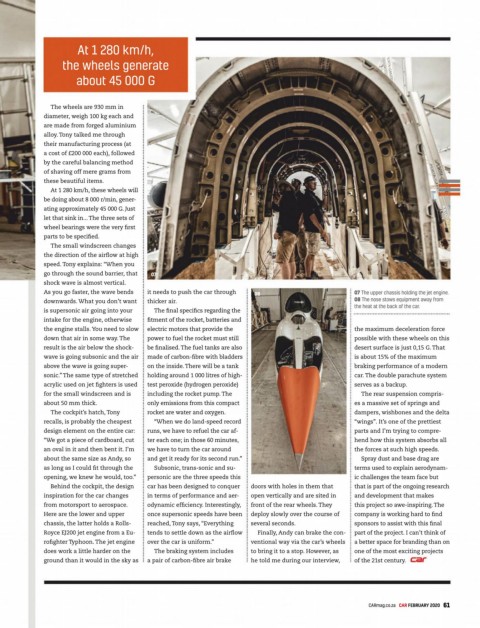
                As you go faster, the wave bends   it needs to push the car through    08                                07 The upper chassis holding the jet engine.
                downwards. What you don’t want     thicker air.                                                          08 The nose stows equipment away from
                                                                                                                         the heat at the back of the car.


                is supersonic air going into your    The  nal speci cs regarding the
                intake for the engine, otherwise    tment of the rocket, batteries and

                the engine stalls. You need to slow   electric motors that provide the                                   the maximum deceleration force
                down that air in some way. The     power to fuel the rocket must still                                   possible with these wheels on this

                result is the air below the shock-  be  nalised. The fuel tanks are also                                 desert surface is just 0,15 G. That
                wave is going subsonic and the air   made of carbon- bre with bladders                                   is about 15% of the maximum

                above the wave is going super-     on the inside. There will be a tank                                   braking performance of a modern
                sonic.” The same type of stretched   holding around 1 000 litres of high-                                car. The double parachute system
                acrylic used on jet  ghters is used   test peroxide (hydrogen peroxide)                                  serves as a backup.

                for the small windscreen and is    including the rocket pump. The                                          The rear suspension compris-
                about 50 mm thick.                 only emissions from this compact                                      es a massive set of springs and
                  The cockpit’s hatch, Tony        rocket are water and oxygen.                                          dampers, wishbones and the delta
                recalls, is probably the cheapest    “When we do land-speed record                                       “wings”. It’s one of the prettiest
                design element on the entire car:   runs, we have to refuel the car af-                                  parts and I’m trying to compre-
                “We got a piece of cardboard, cut   ter each one; in those 60 minutes,                                   hend how this system absorbs all
                an oval in it and then bent it. I’m   we have to turn the car around                                     the forces at such high speeds.
                about the same size as Andy, so    and get it ready for its second run.”                                   Spray dust and base  drag are

                as long as I could  t through the    Subsonic, trans-sonic and su-                                       terms used to explain aerodynam-
                opening, we knew he would, too.”   personic are the three speeds this                                    ic challenges the team face but
                  Behind the cockpit, the design   car has been designed to conquer   doors with holes in them that      that is part of the ongoing research
                inspiration for the car changes    in terms of performance and aer-   open vertically and are sited in   and development that makes
                from motorsport to aerospace.      odynamic ef ciency. Interestingly,   front of the rear wheels. They   this project so awe-inspiring. The


                Here are the lower and upper       once supersonic speeds have been   deploy slowly over the course of   company is working hard to  nd
                chassis, the latter holds a Rolls-  reached, Tony says, “Everything   several seconds.                   sponsors to assist with this  nal

                Royce EJ200 jet engine from a Eu-  tends to settle down as the air ow   Finally, Andy can brake the con-  part of the project. I can’t think of


                ro ghter Typhoon. The jet engine   over the car is uniform.”          ventional way via the car’s wheels   a better space for branding than on
                does work a little harder on the     The braking system includes      to bring it to a stop. However, as   one of the most exciting projects

                ground than it would in the sky as   a pair of carbon- bre air brake   he told me during our interview,   of the 21st century.


                                                                                                                              CARmag.co.za   CAR FEBRUARY 2020  61

