


Page 8 - (DK Eyewitness) Travel Guide - Brittany
P. 8
6 HOW T O USE THIS GUIDE
HOW TO USE THIS GUIDE
This Eyewitness Travel Guide helps you with the help of maps, photographs and
to get the most from your stay in Brittany. illustrations. The Travellers’ Needs section
It provides detailed practical information gives detailed information about hotels,
and expert recommendations. Introducing restaurants, shops and markets, entertain
Brittany maps the entire region, sets it in ment and sports. The Survival Guide,
its historical and cultural context. The six provides practical advice on everything
regional chapters describe important sights from transport to personal safety.
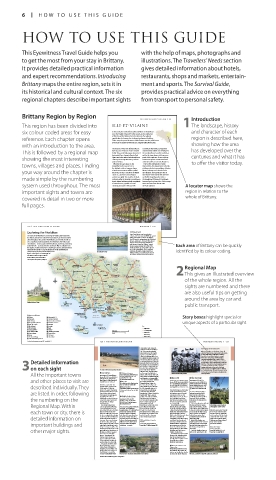
Brittany Region by Region
BRIT T AN Y REGION B Y REGION 59 Introduction
This region has been divided into ILLE-ET-VILAINE 1The landscape, history
six colour-coded areas for easy In the north, the Côte d’Émeraude and Mont-St-Michel face and character of each
onto the English Channel. Further south, at the confluence
reference. Each chapter opens of the Ille and the Vilaine rivers, lies Rennes, the regional region is described here,
capital, which is famous for its elegant parliament building.
To the east, the proud fortresses of the Breton marches, which once
protected the duchy of Brittany, face neighbouring Normandy.
with an introduction to the area. The beaches of the Côte d’Émeraude are centuries. In the towns, a prosperous showing how the area
This is followed by a regional map lined by a succession of resorts. But well and influential middle class developed; has developed over the
the medieval houses in Vitré and Dol, as
before this part of Brittany was discovered
by tourists, Pierre-Auguste Renoir, Paul
well as the town houses in Rennes, are
showing the most interesting Signac and other artists had already been proof of this opulence. As acts of piety, centuries and what it has
struck by its beauty when they came to
trades men’s guilds commissioned the
artists of Laval to create rich altarpieces.
paint in St-Briac.
towns, villages and places. Finding Whether they are drawn to the From Celtic mythology to French to offer the visitor today.
megalithic Roche-aux-Fées or to
Romanticism, the département of the Ille-
et-Vilaine also has two emblems of Breton
the fortified castle in Fougères, lovers
your way around the chapter is of ancient monuments will be spoiled literary heritage: one is the the Forêt
de Paimpont, the legendary Forêt de
for choice. On the coast, Mont-St-Michel
stands as a jewel of Gothic reli gious
Brocéliande where Merlin fell under the
made simple by the numbering architecture, while the citadel in St-Malo spell of the fairy Vivian; the other is
encloses within its ramparts several luxury
the lugubrious Château de Combourg,
hotels. Inland, noble men built a multitude
haunted by the ghost of the 19th-century
system used throughout. The most of manor houses, symbols of social writer and statesman the Vicomte A locator map shows the
de Chateaubriand.
standing, during the 16th and 17th
important sights and towns are region in relation to the
covered in detail in two or more whole of Brittany.
full pages.
178 BRIT T AN Y REGION B Y REGION MORBIHAN 179
Exploring the Morbihan Slender stone columns that form the cloisters of Mont-St-Michel Abbey
Getting Around
View of the waterfront town of Cancale, the oyster capital of Brittany
From Paris, Vannes can be reached in
The south of the Morbihan is crossed by the Vilaine, which flows into 3 hours and 10 minutes by TGV (high-speed
the Atlantic just west of La Roche-Bernard. Vannes, on the far northern train), and Lorient in 3 hours 45 minutes.
side of the gulf, is the capital of the Morbihan, and a lively city with an The N24 and its continuation, the N166, link
Rennes and Vannes. The fast N165, almost
ever-expanding student population. The Morbihan’s two other major
conurbations – Lorient, a port with five harbours, and Auray, a charming all of it a dual carriageway, links Nantes
with Vannes, Auray and Lorient. Several
medieval town – are located further northwest. Water is ubiquitous in minor roads, including the D780, D781, Each area of Brittany can be quickly
this region; countless rivers have carved deep canyons, and rias (ancient D199 and D101, run around the edge of
valleys flooded by the sea) go far inland. The Golfe du Morbihan is the Golfe du Morbihan. The best way of identified by its colour coding.
almost closed and is thus sheltered from the The citadel at Port-Louis which provides a comprehensive view of
exploring the gulf is, however, by boat,
rigours of the open sea. Although the the islands and their beautiful coastlines.
Morbihan’s inland region attracts Loudéac,
fewer visitors, it has beautiful Fo rê t d e Q u é n e c a n St-Brieuc
countryside and pretty villages. Gourin Plouray Dinan
Ellé
Quimper Rohan La Trinité- Mauron
GUÉMÉNÉ-
SUR-SCORFF PONTIVY Porhoët Regional Map
L a n o u é e
LE FAOUËT Canal de Nantes Fo rê t d e
St-Fiacre KERNASCLÉDEN Pluméliau Naizin 2This gives an illustrated overview
Scorff Bubry Réguiny JOSSELIN Lac au duc PLOËRMEL Rennes
Plouay Guer of the whole region. All the
Quimper BAUD Locminé Guéhenno
Blavet
MORBIHAN
Saint-Jean- sights are numbered and there
HENNEBONT Brévelay
Guidel Pluvigner Claie Malestroit
Lanester L a n d e s d e L a n v a u x La Gacilly Aff
Landévant Grand-Champ are also useful tips on getting
Ploemeur Oust
LORIENT Elven
Forteresse de Arz
STE-ANNE-
PORT-LOUIS Largoët d’Elven ROCHEFORT-
Larmor-Plage D’AURAY EN-TERRE around the area by car and
Belz AURAY
Basilica at Ste-Anne-d’Auray Êtel Le Bono VANNES QUESTEMBERT
Port-Tudy LA TRINITÉ-SUR- Parc Zoologique public transport.
ÎLE DE GROIX Plouharnel MER Arradon de Branféré Péaule Vilaine
CARNAC LOCMARIAQUER GOLFE DU Muzillac
Port-Navalo MORBIHAN
Pte. de
Kerpenhir Château LA ROCHE-
de Kerlévenan
PRESQU’ÎLE DE BERNARD
Sights at a Glance QUIBERON Baie de St Gildas Château Camoël Nantes Story boxes highlight special or
de Suscinio
1 Lorient r Vannes pp192–5 Quiberon Quiberon de Rhuis
2 Port-Louis t La Roche-Bernard
3 Île de Groix y Questembert a Pontivy La Baule unique aspects of a particular sight.
4 Presqu’île de Quiberon u Rochefort-en-Terre
5 Belle-Île-en-Mer i Ploërmel ÎLE D’HOUAT
6 Île de Houat o Josselin Sauzon ÎLE DE Key
7 Île de Hoëdic p Baud BELLE-ÎLE- Le Palais HOËDIC Major road
8 Carnac pp184–5 a Pontivy EN-MER 0 kilometres Secondary road
9 La Trinité-sur-Mer s Guéméné-sur-Scorff 0 miles 10 20 Minor road
0 Locmariaquer d Kernascléden Locmaria Main railway
q Auray f Le Faouët
w Ste-Anne-d’Auray g Hennebont Minor railway
e Golfe du Morbihan pp188–91 Regional border
For hotels and restaurants see pp228–9 and pp241–3 126 BRIT T AN Y REGION B Y REGION For keys to symbols see back flap NOR THERN FINISTÈRE 127
communities and seminaries –
and from its religious buildings. The Story of the Johnnies
The 12th-century cathedral, When Henri Olivier, an inhabitant of Roscoff,
which towers over the market sailed for Plymouth in a ship loaded with onions,
square, is one of the very few he was unwittingly establishing a tradition.
churches in Brittany still to have Hundreds of agricultural workers, many of
its original ciborium (canopy). This whom were very young, followed Olivier’s
example, going from port to port in Wales,
Detailed information one takes the form of a palm tree, Scotland and England selling strings of onions
its spreading branches covered in
to housewives, who nick named them Johnnies.
putti, vine leaves and ears of corn.
Until the 1930s, this seasonal migration was an
According to an ancient tradi tion,
3on each sight The beach at the elegant coastal resort of Carantec the ciborium is suspended over essential opportunity for trade, and many
families who lived on the coast of Brittany
the altar. Other notable features
began to adopt such British habits as drinking
are a 16-petal rose window
tea and playing darts. They also began to speak
(1431), trompe-l’œil decoration
Breton interspersed with various English words
All the important towns 2 Carantec + Château du Taureau on the organ, built by Robert 4 Roscoff 5 Île de Batz and expressions.
Johnnies with their strings of onions
Open Guided tours, which include a
Dallam, 16th-century choir stalls
Road map B1. * 2,800. @ from
with carvings of fabulous animals,
boat trip, available from Apr–Sep.
Morlaix. n 4 Rue Pasteur; (02) 98 67
Tel (02) 98 62 29 73. &
and reliquaries containing skulls.
and other places to visit are 00 43. ( Thu am. _ Pardon de ∑ chateaudutaureau.com. The most remarkable build ing Road map B1. * 3,700. £ @ from Road map B1. * 740. 4 4
Notre-Dame-de-Callot (Sun after 15
} Île Callot
Aug). ∑ tourisme-morlaix.fr
in St-Pol is, however, the
motorboats run by CFTM (02 98 61
Morlaix. g n Quai d’Auxerre; (02) 98
Chapelle Notre-Dame-du-
Accessible from Grève Blanche at low
78 87), Armein (02 98 61 74 04) and
61 12 13. ( Wed am. _ Pardon de
described individually. They With the arrival of the first tide. Check with the tourist office. Kreisker, whose belfry is the Ste-Barbe (mid-Jul); Fête de l’Oignon Armor Excursions (02 98 61 79 66)
tallest in Brittany; the climb up
foreign visitors, between the
(mid-Aug). ∑ roscoff-tourisme.com
E Musée Maritime
from Roscoff. n (02) 98 61 75 70.
8 Rue Albert-Louppe. Tel (02) 98 67 00
1870s and the 1900s, the
_ Pardon de Ste-Anne (late Jul).
its 170-step spiral staircase is
history of Carantec (Karanteg 43. Open mid-Jun–mid-Sep: Fri–Wed rewarded by a breathtaking From the fish farms at Ste-Barbe Separated from Roscoff by a
are listed in order, following One of these visitors found pm. & forming the Ceinture Dorée (the old harbour, most of Roscoff narrow channel, the Îsle de
view of the bay, the fields
in Breton) took a decisive turn.
to the seaweed boats in the
“golden belt” that is a prime
is focused on the sea. The
the location enchanting and,
Batz (Enez Vaz in Breton) is a
3 St-Pol-de-Léon
small island just 4 km (3 miles)
largely thanks to him, a
Église Notre-Dame-de-Kroaz-
producer of early vegetables),
the numbering on the fashionable coastal resort was Road map B1. * 7,400. £ and, below, the old town of Baz, built with funds from long and 2 km (1 mile) wide.
merchants and privateers (in
It has about 20 sandy beaches
created. Its smart hotels and
St-Pol. From this vantage point
n Place de l’Évêché; (02) 98 69
1515), has caravels carved on
there is a bird’s-eye view of
and creeks.
elegant villas no longer
05 69. ( Tue. 8 free in summer
Regional Map. Within exist, however. ∑ saintpoldeleon.fr other jewels of St-Pol’s its exterior walls. The crossing from Roscoff’s old Jardin Exotique Georges-Delaselle, the
The magical views here
Renaissance architecture, such
Roscoff (Rosk o Gozen in
harbour, or from the groyne,
colonial garden on the Île de Batz
This city is the capital of Brittany’s
Breton), whose port handles
takes only 20 min utes, and the
can be enjoyed by following
as the Maison Prébendale
island attracts up to 4,000 visitors
artichoke- and cauliflower-
a marked footpath running
ferry links with Plymouth, has
(canons’ house) on Place du
each town or city, there is from Grève Blanche to the pine growing region. St-Pol (Kastell Paol 4-Août-1944, the Hôtel de a long, if stormy history with a day over certain summer week- ruined Romanesque Chapelle
wood at Penn al Lann. The
in Breton) is named after Pol-
Britain. Not only did Roscovites
de Ste-Anne and the Jardin
Keroulas in Rue du Collège, and
ends. Outside the high season,
Aurélien, a Welsh evangelizer
the Manoir de Kersaliou, on the
Batz is a haven of tranquility,
two-hour walk takes in Porspol
Exotique George-Delaselle,
fight naval battles with the
road to Roscoff, a charming
British and suffer their raids, they with far fewer visitors than
beach, a rocky platform known
in the southeast of the island,
who founded a monastery here
detailed information on as the Chaise du Curé (Parson’s in the 6th century. Soon after, 16th-century manor house. were also accomplices in continue to flock to the Île de created in 1897. Some 1,500
Chair) and another beach, Le
smuggling. In the 18th century,
it became the see of the diocese
plants from southern Africa,
Bréhat (see p104).
California and New Zealand
of Léon. The clergy’s powerful
Most of the islanders are
Cosmeur. There are also views
R Chapelle Notre-Dame-du-
contraband tea, brandy and
of the Île Callot, with sandy influence here is evident both Kreisker other liquor left Roscoff to be market gardeners. The seaweed thrive in the island’s
important buildings and inlets, and the Île Louët, a small from the number of religious Town centre. Tel (02) 98 69 05 69. landed in Britain. Shipowners that they spread on their small gentle microclimate.
island with a lighthouse and a
Open daily. 8 Belfry (summer). &
plots of land helps produce the
institutions – monastic
grew prosperous, as the fine
best fruit and vegetables in
houses that they built in Rue
keeper’s cottage, as well as the
Y Jardin Exotique
other major sights. Château du Taureau. The castle Armand-Rousseau, Rue Amiral- the region. Georges-Delaselle
was built by the inhabitants of
Réveillère and Place Lacaze-
From the landing stage, an
Porzan Iliz. Tel (02) 98 61 75 65.
alley to the right leads to the
Duthiers clearly show.
Open Apr–Oct: daily. & 8
Morlaix as a defence against
the incursions of English A small museum presents the
pirates. Strengthened by history of the Johnnies, which
Vauban, it later became a was the name given to the
prison. Guided tours of the Roscoff producers who went to
château include not just the Great Britain to sell their
garrison but also a boat trip. distinctive pink onions.
In Carantec itself, the small
Musée Maritime contains E Maison des Johnnies et de
some vintage sailing boats, l’Oignon Rose
including a boat in which 193 48 Rue Brizeau. Tel (02) 98 61 25 48.
British pilots and members of Open mid-Jun–mid-Sep: Mon–Fri;
the Résistance crossed the mid-Sep–mid-Jun: Mon, Tue, Thu & Fri
Channel during World War II. View of St-Pol-de-Léon from the belfry of Notre-Dame-du-Kreisker pm. Closed Jan. & 8 obligatory. Île de Batz, a small treeless island with sandy beaches, off Roscoff
For hotels and restaurants see pp226–7 and pp238–9
006-007_EW_Brittany.indd 6 11/3/16 1:01 PM

