


Page 106 - BBC Wildlife Volume 36 #05
P. 106
YOUR FEEDBACK


          Accessible wildlife
          I read Bo Beolens’ article  WHAT ARE YOUR WILDLIFE                         We asked BBC Wildlife readers
          (Wildlife For All, January 2018)  GARDENING TIPS?                          to send us their best advice on
          with special interest, as over the                                         how to help nature.
          last five years my health and
          fitness has deteriorated badly  JANET PACKHAM          PRIYA AGARWAL
          due to illness. I do not use a  After you have brushed your dog  Leave a corner of your garden
          wheelchair but I cannot walk far  leave the hair out for birds to  untouched to encourage wildlife
          before needing to rest. So I have  collect as nest material (below).  to thrive and give your garden
          not been to nature reserves,                          b
                                                                birds privacy – allow them to
          thinking I would not manage                           feel safe by staying away from
                                                                f
          to get further than the car park.                     their feeding stations.
                                                                t
          His suggestion of benches
          every 75–100 yards sound a very                       NICK TEW
          good solution. Watching the                           Make a small raised bank out of
          birds and other wildlife in my                        e earth and scatter it with wildflower
          garden has been a lifeline while                      seeds.This slope will be drier and
                                                                s
          I was ill, and I look forward to                      w
                                                                warmer than its surroundings and
          interesting times this spring.                        w                         SOPHIE BOXALL
                                                                will provide food for solitary bees.
          Carole Bailey, Fyfield                                                           Put up nestboxes (above) for
                                                                @LAZYCUTTLEFISH           breeding birds and bug hotels for
          Feeding hedgehogs                                        Let ivy grow – when it blooms  invertebrates.Add wildlife-friendly
          One thing that jumped out   EMMA MAGEE                      in autumn,bees and  plants and avoid plastic pots.
          at me in your last issue was  Don’t forget night              butterflies will visit.
          your article on hedgehogs. I  flowering plants                 In early spring,  ALISON CRAVEN
          offer food, water and housing  attract moths,                   birds will come for  Last year I planted honeywort,
          to quite a large number of  especially                          the berries.Last  which flowered twice and
          hedgehogs. I also volunteer  crepuscular                        year,I even saw a  reseeded itself.It’s a very hardy
          with our local rescue centre.  and nocturnal                    blackbird build   plant and very pretty,plus the
           The one thing that concerned   species (right).               a nest in it.    bees love it!
          me was seeing an image of
          two hedgehogs feeding from
          a huge tray of mealworms!
          Mealworms, if eaten as     grandchildren, a motivation  There is no evidence that   a condition called prosopagnosia,
          anything more than an odd  that cannot be criticised.  feeding hedgehogs in gardens   or face-blindness, which is the
          little treat, cause metabolic  BBC Wildlife is usually very  leads to undue pressure on stag   inability to recognise faces.
          bone disease. Feeding too many  good at promoting the concept   beetles or any other species,   Some people with prosopagnosia
          mealworms is actually a lot  of ecological balance in its  populations of which are   cannot recognise facial
          worse than not feeding at all.  articles, but all the more reason  impacted in complex ways by   expressions, such as a smile or
          I only hope readers don’t start  to be careful with advice on the   many factors. For more useful   raised eyebrow. Studies suggest
          offering piles of mealworms.   provision of extra food.  advice on how to help hedgehogs,   about 1 in 50 people may have
          Brian Gort, via email      Richard Clifford, via email  go to www.hedgehogstreet.org.  some form of developmental
                                                                                           prosopagnosia. I think the
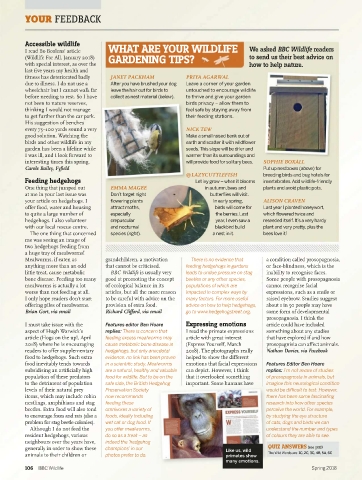
          I must take issue with the  Features editor Ben Hoare  Expressing emotions       article could have included
          aspect of Hugh Warwick’s   replies: There is concern that   I read the primate expressions  something about any studies
          article (Hogs on the up!, April  feeding excess mealworms may   article with great interest  that have explored if and how
          2018) where he is encouraging  cause metabolic bone disease in   (Express Yourself, March  prosopagnisia can affect animals.
          readers to offer supplementary  hedgehogs, but only anecdotal   2018). The photographs really  Nathan Davies, via Facebook
          food to hedgehogs. Such extra  evidence: no link has been proven   helped to show the different
          food inevitably tends towards  in a scientific study. Mealworms   emotions that facial expressions   Features Editor Ben Hoare
          subsidising an artificially high  are a natural, healthy and valuable   can depict. However, I think  replies: I’m not aware of studies
          population of these predators  food for wildlife. But to be on the   that it overlooked something  of prosopagnosia in animals, but
          to the detriment of population  safe side, the British Hedgehog   important. Some humans have  imagine this neurological condition
          levels of their natural prey  Preservation Society                               w
                                                                                           would be difficult to test. However,
          items, which may include robin  now recommends                                   t here has been some fascinating
          nestlings, amphibians and stag  feeding these                                    r esearch into how other species
          beetles. Extra food will also tend  omnivores a variety of                       p perceive the world. For example,
          to encourage foxes and rats (also a  foods, ideally including                    by studying the eye structure
                                                                                           b
          problem for stag beetle colonies).  wet cat or dog food. If                      of cats, dogs and birds we can
                                                                                           o
           Although I do not feed the  you offer mealworms,                                understand the number and types
                                                                                           u
          resident hedgehogs, various  do so as a treat – as                               o of colours they are able to see.
          neighbours over the years have,  indeed the ‘hedgehog
          generally in order to show these  champions’ in our                Like us, wild   QUIZ ANSWERS (see p113)
          animals to their children or   photos prefer to do.                primates show   TheWildWordsare: 1C, 2C,3C, 4B, 5A, 6C
                                                                             many emotions.
          106  BBC Wildlife                                                                               Spring 2018

