


Page 99 - BBC Wildlife Volume 36 #05
P. 99
Q&A


         Q BIRDS
          Do Britain’s wrens vary
          in how they cope with
          the cold?

           A  Yes.A BTO study has
           found that birds living in
           east Scotland are larger
           than those from south-east
           England, with five per cent           Q  MAMMALS
           more body mass.This means
           they can lay down more fat,
           making them more resilient
           to chilly weather. SM


                                               A  Echolocating bats’ ears function much   hand, big ears can help generate lift,
                                               like radar dishes. And the bigger the   like subsidiary wings, and can also be
                                               dishes, the more sensitive they are. But   deployed as effective air brakes. It may be
                                               big ears are heavy, unwieldy and hamper   no coincidence that long-eared bats tend
                                               forward progress through the air. Indeed,   to hunt in cluttered woodland habitats,
                                               experiments show that long-eared bats   where they can afford to sacrifice a bit of
                                               expend more energy in flight than their   speed for better hearing. g.
                                               lesser-endowed cousins. On the other   Stuart Blackman


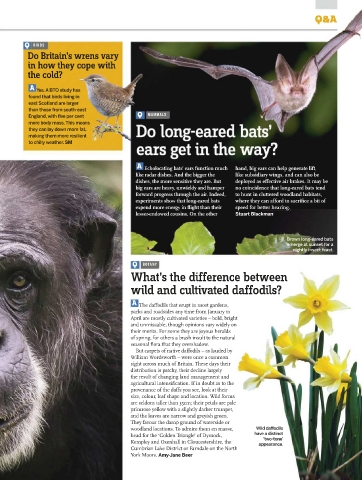
                                                                                                  Brown long-eared bats
                                                                                                  emerge at sunset for a
                                                                                                    nightly insect feast.

                                              Q  BOTANY
                                             What’s the difference between

                                             wild and cultivated daffodils?

                                              A  The daffodils that erupt in most gardens,
                                             parks and roadsides any time from January to
                                             April are mostly cultivated varieties – bold, bright
                                             and unmissable, though opinions vary widely on
                                             their merits. For some they are joyous heralds
                                             of spring, for others a brash insult to the natural
                                             seasonal flora that they overshadow.
                                               But carpets of native daffodils – as lauded by
                                             William Wordsworth – were once a common
                                             sight across much of Britain. These days their
                                             distribution is patchy, their decline largely
                                             the result of changing land management and
                                             agricultural intensification. If in doubt as to the
                                             provenance of the daffs you see, look at their
                                             size, colour, leaf shape and location. Wild forms
                                             are seldom taller than 35cm; their petals are pale
                                             primrose yellow with a slightly darker trumpet,
                                             and the leaves are narrow and greyish green.
                                             They favour the damp ground of waterside or
                                             woodland locations. To admire them en masse,  Wild dafodils
                                             head for the ‘Golden Triangle’ of Dymock,  have a distinct
                                                                                          ‘two-tone’
                                             Kempley and Oxenhall in Gloucestershire, the  appearance.
                                             Cumbrian Lake District or Farndale on the North
                                             York Moors. Amy-Jane Beer

