


Page 106 - (DK Eyewitness) Top 10 Travel Guide - Beijing
P. 106
104 ❯❯ Beijing Area by Area
Stupa Forest
6
Temple
28 miles (45 km) W of
Beijing • 6086 2505
• Subway: Pingguo Yuan
(1 hr), then bus 931 or
tourist bus 7 • Open
8am–5pm daily • Adm
Near the parking lot
for the Tanzhe Temple
is this even more fasci
nating temple, notable
for its collection of brick
stupas hidden among
the foliage. Every single
stupa was constructed
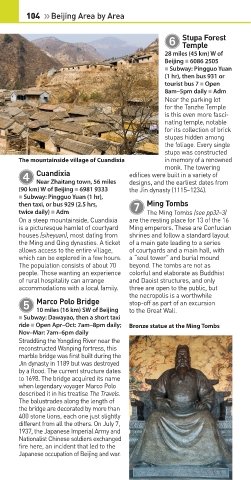
The mountainside village of Cuandixia in memory of a renowned
monk. The towering
Cuandixia
4 edifices were built in a variety of
designs, and the earliest dates from
Near Zhaitang town, 56 miles
(90 km) W of Beijing • 6981 9333 the Jin dynasty (1115–1234).
• Subway: Pingguo Yuan (1 hr),
Ming Tombs
then taxi, or bus 929 (2.5 hrs, 7
twice daily) • Adm The Ming Tombs (see pp32–3)
On a steep mountainside, Cuandixia are the resting place for 13 of the 16
is a picturesque hamlet of courtyard Ming emperors. These are Confucian
houses (siheyuan), most dating from shrines and follow a standard layout
the Ming and Qing dynasties. A ticket of a main gate leading to a series
allows access to the entire village, of court yards and a main hall, with
which can be explored in a few hours. a “soul tower” and burial mound
The population consists of about 70 beyond. The tombs are not as
people. Those wanting an experience colorful and elab orate as Buddhist
of rural hospitality can arrange and Daoist structures, and only
accommodations with a local family. three are open to the public, but
the necropolis is a worthwhile
Marco Polo Bridge
5 stopoff as part of an excursion
to the Great Wall.
10 miles (16 km) SW of Beijing
• Subway: Dawayao, then a short taxi
ride • Open Apr–Oct: 7am–8pm daily; Bronze statue at the Ming Tombs
Nov–Mar: 7am–6pm daily
Straddling the Yongding River near the
reconstructed Wanping fortress, this
marble bridge was first built during the
Jin dynasty in 1189 but was destroyed
by a flood. The current struc ture dates
to 1698. The bridge acquired its name
when legendary voyager Marco Polo
described it in his treatise The Travels.
The balustrades along the length of
the bridge are decorated by more than
400 stone lions, each one just slightly
different from all the others. On July 7,
1937, the Japanese Imperial Army and
Nationalist Chinese soldiers exchanged
fire here, an incident that led to the
Japanese occupation of Beijing and war.
Eyewitness Travel – Top 10 series LAYERS PRINTED:
Two-column, 8.5pt grid “UK” LAYER
(SourceReport v.1.9)
102-105_Top_10_Beijing.indd 104 27/06/2017 14:33
Date 24th June 2015
Size 100mm x 191mm

