


Page 128 - (DK Eyewitness) Top 10 Travel Guide - Beijing
P. 128
126  ❯❯  Top 10 Beijing

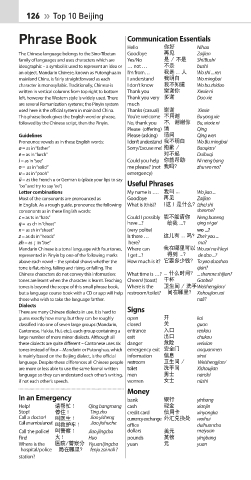
     Phrase Book              Communication Essentials
                              Hello           Nihao
     The Chinese language belongs to the Sino-Tibetan   Goodbye  Zaijian
     family of languages and uses characters which are   Yes/No  Shi/Bushi
     ideographic – a symbol is used to represent an idea or   … not …        bushi
     an object. Mandarin Chinese, known as Putonghua in   I’m from…  Wo shi ... ren
     mainland China, is fairly straightforward as each   I understand  Wo mingbai
     character is monosyllabic. Traditionally, Chinese is   I don’t know  Wo bu zhidao
     written in vertical columns from top right to bottom   Thank you  Xiexie ni
     left, however the Western style is widely used. There   Thank you very    Duo xie
     are several Romanization systems; the Pinyin system   much
     used here is the official system in mainland China.    Thanks (casual)        Xiexie
     This phrase book gives the English word or phrase,   You’re welcome    Bu yong xie
     followed by the Chinese script, then the Pinyin.  No, thank you    Bu, xiexie ni
                              Please  (offering)    Qing
     Guidelines               Please (asking)    Qing wen
     Pronounce vowels as in these English words:  I don’t understand      Wo Bu mingbai
     a = as in “father”       Sorry/Excuse me!    Baoqian/
     e = as in “lurch”                        Duibuqi
     i = as in “see”          Could you help    Ni neng bang
     o =  as in “solid”       me please? (not    zhu wo ma?
     u = as in “pooh”         emergency)
     ü = as the French u or German ü (place your lips to say
     “oo” and try to say “ee”)  Useful Phrases
     Letter combinations      My name is ….     Wo jiao ...
     Most of the consonants are pronounced as    Goodbye   Zaijian
     in English. As a rough guide, pronounce the following  What is (this)?    (zhe) shi
     consonants as in these English words:          shenme?
     c = as ts in “hats”      Could I possibly    Neng buneng
     q =  as ch in “cheat”    have ...?         qing ni gei
     x = as sh in “sheet”     (very polite)   wo ...?
     z = as ds in “heads”     Is there …         Zhe’r you ...
     zh = as  j  in “Joe”      here?           ma?
     Mandarin Chinese is a tonal language with four tones,  Where can   Wo zai na li keyi
     represented in Pinyin by one of the following marks    I get ...?    de dao ...?
     above each vowel – the symbol shows whether the   How much is it?    Ta yao duoshao
     tone is flat, rising, falling and rising, or falling. The            qian?
     Chinese characters do not convey this information:   What time is …?    ... shenme shijian?
     tones are learnt when the character is learnt. Teaching  Cheers! (toast)     Ganbei!
     tones is beyond the scope of this small phrase book,   Where is the  Weishengjian/
     but a language course book with a CD or app will help  restroom/toilet?    Xishoujian zai
     those who wish to take the language farther.         nali?
     Dialects
     There are many Chinese dialects in use. It is hard to   Signs
     guess exactly how many, but they can be roughly   open   kai
     classified into one of seven large groups (Mandarin,   closed        guan
     Cantonese, Hakka, Hui, etc.), each group containing a   entrance  renkou
     large number of more minor dialects. Although all   exit  chukou
     these dialects are quite different – Cantonese uses six   danger        weixian
     tones instead of four – Mandarin or Putonghua, which  emergency exit       anquanmen
     is mainly based on the Beijing dialect, is the official   information   xinxi
     language. Despite these differences all Chinese people  restroom         Weishengjian/
     are more or less able to use the same formal written   toilet  Xishoujian
     language so they can understand each other’s writing,  men  nanshi
     if not each other’s speech.  women       nüshi
                              Money
     In an Emergency          bank            yinhang
     Help!           Qing bangmang  cash      xianjin
     Stop!             Ting zhu   credit card  xinyongka
     Call a doctor!    Jiao yisheng   currency exchange    waihui
     Call an ambulance!         Jiao jiuhuche  office  duihuanchu
     Call the police!    Jiao jiingcha  dollars        meiyuan
     Fire!           Huo      pounds          yingbang
     Where is the    Yiyuan/jingcha   yuan    yuan
      hospital/police         fenju zai nali ?
     station?
     Eyewitness Travel – Top 10 series  LAYERS PRINTED:
     Phrase book         “UK” LAYER
     (SourceReport v1)
 126-128_Top_10_Beijing.indd   126                    27/06/2017   14:33
     Date 3rd June 2015
     Size 100mm x 191mm

