


Page 149 - (DK Eyewitness) Travel Guide - Washington, DC
P. 149
F AR THER AFIELD 147
Frederick Douglass (1817–95)
Born a slave around 1818, Frederick Douglass became the leading voice
in the abolitionist movement that fought to end slavery in the United
States. Douglass was taught to read and write by his white owners. At
the age of 20 he fled to Europe. British friends in the anti-slavery move-
ment purchased him from his former masters, and he was at last a free
man. For most of his career he lived in New York, where he worked as
a spokesman for the abolitionist movement. A brilliant speaker, he
was sent by the American Anti-Slavery Society on a lecture tour and
won added fame with the publication of his autobiography in 1845.
In 1847 he became editor of the anti-slavery newspaper The North
Star, named after the constellation point followed by escaping
slaves on their way to freedom. During the Civil War (see p23),
Douglass was an advisor to President Lincoln and fought for
the constitutional amendments that guaranteed equal
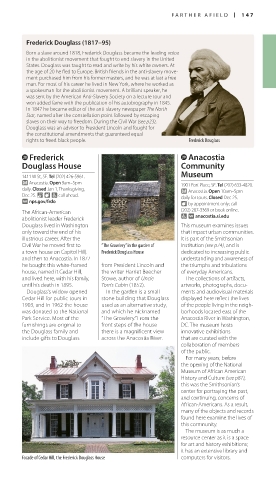
rights to freed black people. Frederick Douglass
k Frederick l Anacostia
Douglass House Community
Museum
1411 W St, SE. Tel (202) 426-5961.
q Anacostia. Open 9am–5pm 1901 Fort Place, SE. Tel (202) 633-4820.
daily. Closed Jan 1, Thanks giving, q Anacostia. Open 10am–5pm
Dec 25. & 8 7 call ahead. daily for tours. Closed Dec 25.
∑ nps.gov/frdo 8 by appoint ment only; call
The African-American (202) 287-3369 or book online.
abolitionist leader Frederick 7 ∑ anacostia.si.edu
Douglass lived in Washington This museum examines issues
only toward the end of his that impact urban communities.
illustrious career. After the It is part of the Smithsonian
Civil War he moved first to “The Growlery” in the garden of Institution (see p74), and is
a town house on Capitol Hill, Frederick Douglass House dedicated to increasing public
and then to Anacostia. In 1877 under standing and awareness of
he bought this white-framed from President Lincoln and the triumphs and tribulations
house, named it Cedar Hill, the writer Harriet Beecher of everyday Americans.
and lived here, with his family, Stowe, author of Uncle The collections of artifacts,
until his death in 1895. Tom’s Cabin (1852). artworks, photographs, docu-
Douglass’s widow opened In the garden is a small ments and audiovisual materials
Cedar Hill for public tours in stone building that Douglass displayed here reflect the lives
1903, and in 1962 the house used as an alternative study, of the people living in the neigh-
was donated to the National and which he nicknamed borhoods located east of the
Park Service. Most of the “The Growlery.” From the Anacostia River in Washington,
furnishings are original to front steps of the house DC. The museum hosts
the Douglass family and there is a magnificent view innovative exhibitions
include gifts to Douglass across the Anacostia River. that are curated with the
collaboration of members
of the public.
For many years, before
the opening of the National
Museum of African American
History and Culture (see p81),
this was the Smithsonian’s
center for portraying the past,
and continuing, concerns of
African-Americans. As a result,
many of the objects and records
found here examine the lives of
this community.
The museum is as much a
resource center as it is a space
for art and history exhibitions;
it has an extensive library and
Facade of Cedar Hill, the Frederick Douglass House computers for visitors.
146-147_EW_Washington.indd 147 04/04/17 2:39 pm

