


Page 24 - (DK Eyewitness) Travel Guide - Washington, DC
P. 24
22 INTRODUCING W ASHINGT ON , DC
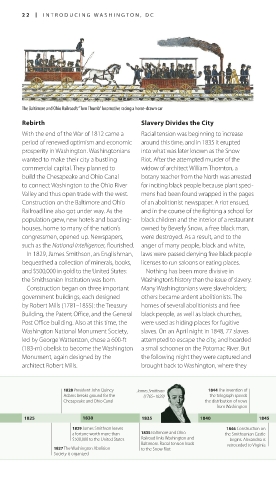
The Baltimore and Ohio Railroad’s “Tom Thumb” locomotive racing a horse-drawn car
Rebirth Slavery Divides the City
With the end of the War of 1812 came a Racial tension was beginning to increase
period of renewed optimism and economic around this time, and in 1835 it erupted
prosperity in Washington. Washingtonians into what was later known as the Snow
wanted to make their city a bustling Riot. After the attempted murder of the
commer cial capital. They planned to widow of architect William Thornton, a
build the Chesapeake and Ohio Canal botany teacher from the North was arrested
to connect Washington to the Ohio River for inciting black people because plant speci
Valley and thus open trade with the west. mens had been found wrapped in the pages
Construction on the Baltimore and Ohio of an abolitionist newspaper. A riot ensued,
Railroad line also got under way. As the and in the course of the fighting a school for
population grew, new hotels and boarding black children and the interior of a restaurant
houses, home to many of the nation’s owned by Beverly Snow, a free black man,
congressmen, opened up. Newspapers, were destroyed. As a result, and to the
such as the National Intelli gencer, flourished. anger of many people, black and white,
In 1829, James Smithson, an Englishman, laws were passed denying free black people
bequeathed a collection of minerals, books, licenses to run saloons or eating places.
and $500,000 in gold to the United States: Nothing has been more divisive in
the Smithsonian Institution was born. Washington’s history than the issue of slavery.
Construction began on three important Many Washingtonians were slaveholders;
government buildings, each designed others became ardent abolitionists. The
by Robert Mills (1781–1855): the Treasury homes of several abolitionists and free
Building, the Patent Office, and the General black people, as well as black churches,
Post Office building. Also at this time, the were used as hiding places for fugitive
Washington National Monument Society, slaves. On an April night in 1848, 77 slaves
led by George Watterston, chose a 600ft attempted to escape the city, and boarded
(183m) obelisk to become the Washington a small schooner on the Potomac River. But
Monument, again designed by the the following night they were captured and
architect Robert Mills. brought back to Washington, where they
1828 President John Quincy James Smithson 1844 The invention of
Adams breaks ground for the (1765–1829) the telegraph speeds
Chesapeake and Ohio Canal the distribution of news
from Washington
1825 1830 1835 1840 1845
1829 James Smithson leaves 1846 Construction on
a fortune worth more than 1835 Baltimore and Ohio the Smithsonian Castle
$500,000 to the United States Railroad links Washington and begins. Alexandria is
Baltimore. Racial tension leads retroceded to Virginia
1827 The Washington Abolition to the Snow Riot
Society is organized
022-023_EW_Washington.indd 22 04/04/17 2:38 pm
Eyewitness Travel LAYERS PRINTED:
History Portrait template “UK” LAYER
(Source v1.2)
Date 20th August 2012
Size 125mm x 217mm

