


Page 12 - History of War - Issue 01-14
P. 12
DISPATCHES


                 Military news and opinion from around the globe, including a new theory on Alexander’s
                 death, the uncovering of some rare First World War photographs and a Boer Wars bugle


                GREAT WAR DEATH TOLL UNDERESTIMATED


                BY UP TO A MILLION MEN


                New book reveals errors and miscalculations

                    he First World War claimed   established,” he says. “So there
                    up to a million more lives   is confusion concerning places
                    than previously calculated,   whose borders had shifted; there
                    according to a new book.   is inconsistency in recording the
                T Antoine Prost, Professor   deaths of soldiers from sickness
                Emeritus of History at the   and prisoners of war who died in
                University of Paris, is one of the   captivity; and there is uncertainty
                academics who have contributed   surrounding the number of
                to The Cambridge History Of The   soldiers reported missing.”
                First World War, and in his essay   The book also claims that the
                he argues that a combination of   number of men who suffered
                error, confusion and an inclination   from shell-shock may have been
                to publish conservative figures   underestimated. Says editor
                led to an underestimation of the   Jay Winter of Yale University,
                death toll – by anywhere between   “Studies show that stress in the
                500,000 and a million men.  Great War was probably more
                  While studying analyses of   intense than in later conflicts,
                casualty lists across participant   and yet physicians were reluctant
                nations, Professor Prost    to diagnose many injuries as
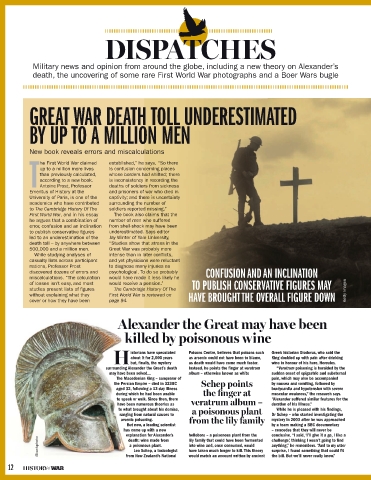
                discovered dozens of errors and   psychological. To do so probably   CONFUSION AND AN INCLINATION
                miscalculations. “The calculation   would have made it less likely he
                of losses isn’t easy, and most   would receive a pension.”  TO PUBLISH CONSERVATIVE FIGURES MAY
                studies present lists of figures   The Cambridge History Of The                                               Getty Images
                without explaining what they   First World War is reviewed on   HAVE BROUGHT THE OVERALL FIGURE DOWN
                cover or how they have been   page 94.


                                               Alexander the Great may have been

                                                 killed by poisonous wine


                                                   istorians have speculated   Poisons Centre, believes that poisons such   Greek historian Diodorus, who said the
                                                   about it for 2,000 years   as arsenic could not have been to blame,   King doubled up with pain after drinking
                                             Hbut, finally, the mystery   as death would have come much faster.   wine in honour of his hero, Hercules.
                                           surrounding Alexander the Great’s death   Instead, he points the finger at veratrum   “Veratrum poisoning is heralded by the
                                            may have been solved…       album – otherwise known as white   sudden onset of epigastric and substernal
                                              The Macedonian King – conqueror of                    pain, which may also be accompanied
                                             the Persian Empire – died in 323BC   Schep points      by nausea and vomiting, followed by
                                              aged 32, following a 12-day illness                   bradycardia and hypotension with severe
                                              during which he had been unable   the finger at       muscular weakness,” the research says.
                                              to speak or walk. Since then, there                   “Alexander suffered similar features for the
                                               have been numerous theories as   veratrum album –    duration of his illness.”
                                               to what brought about his demise,   a poisonous plant   While he is pleased with his findings,
                                               ranging from natural causes to                       Dr Schep – who started investigating the
                                                arsenic poisoning.      from the lily family        mystery in 2003 after he was approached
                                                  But now, a leading scientist                      by a team making a BBC documentary
                                                 has come up with a new                             – concedes that they will never be
                                                  explanation for Alexander’s   hellebore – a poisonous plant from the   conclusive. “I said, ‘I’ll give it a go, I like a
                   iStockphoto                    from New Zealand’s National   into wine and, once consumed, would   anything,” he remembers. “And to my utter
                                                                                                    challenge,’ thinking I wasn’t going to find
                                                                        lily family that could have been fermented
                                                  death: wine made from
                                                   a poisonous plant.
                                                                                                    surprise, I found something that could fit
                                                                        have taken much longer to kill. This theory
                                                    Leo Schep, a toxicologist
                                                                                                    the bill. But we’ll never really know.”
                                                                        would match an account written by ancient
        12    HISTORY  WAR
                      of

