


Page 52 - History of War - Issue 01-14
P. 52
THE US PACIFIC CAMPAIGN


                                                                                                                                Getty
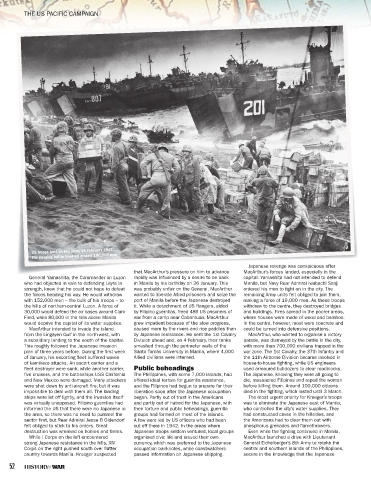
                 US troops land on Iwo Jima, 19 February 1945.
                 The ensuing battle involved around 100,000 men

                                                                                             Japanese revenge was conspicuous after
                                                     that MacArthur’s pressure on him to advance   MacArthur’s forces landed, especially in the
                General Yamashita, the Commander on Luzon   rapidly was infl uenced by a desire to be back   capital. Yamashita had not intended to defend
              who had objected in vain to defending Leyte in   in Manila by his birthday on 26 January. This   Manila, but Navy Rear Admiral Iwabachi Sanji
              strength, knew that he could not hope to defeat   was probably unfair on the General. MacArthur   ordered his men to fi ght on in the city. The
              the forces heading his way. He would withdraw   wanted to liberate Allied prisoners and seize the   remaining Army units felt obliged to join them,
              with 152,000 men – the bulk of his troops – to   port of Manila before the Japanese destroyed   making a force of 19,000 men. As these troops
              the hills of northern-central Luzon. A force of   it. While a detachment of US Rangers, aided   withdrew to the centre, they destroyed bridges
              30,000 would defend the air bases around Clark   by Filipino guerrillas, freed 486 US prisoners of   and buildings. Fires spread in the poorer areas,
              Field, while 80,000 in the hills above Manila   war from a camp near Cabantuan, MacArthur   where houses were made of wood and bamboo.
              would deprive the capital of its water supplies.  grew impatient because of the slow progress,   In the centre, however, most were concrete and
                MacArthur intended to invade the island   caused more by the rivers and rice paddies than   could be turned into defensive positions.
              from the Lingayen Gulf in the north-west, with   by Japanese resistance. He sent the 1st Cavalry   MacArthur, who wanted to organise a victory
              a subsidiary landing to the south of the capital.   Division ahead and, on 4 February, their tanks   parade, was dismayed by the battle in the city,
              This roughly followed the Japanese invasion   smashed through the perimeter walls of the   with more than 700,000 civilians trapped in the
              plan of three years before. During the fi rst week   Santo Tomás University in Manila, where 4,000   war zone. The 1st Cavalry, the 37th Infantry and
              of January, his escorting fl eet suffered waves   Allied civilians were interned.  the 11th Airborne Division became involved in
              of kamikaze attacks. An escort carrier and a                                 house-to-house fi ghting, while US engineers
              fl eet destroyer were sunk, while another carrier,   Public beheadings        used armoured bulldozers to clear roadblocks.
              fi ve cruisers, and the battleships USS California   The Philippines, with some 7,000 islands, had   The Japanese, knowing they were all going to
              and New Mexico were damaged. Many attackers   offered ideal terrain for guerrilla resistance,   die, massacred Filipinos and raped the women
              were shot down by anti-aircraft fi re, but it was   and the Filipinos had begun to prepare for their   before killing them. Around 100,000 citizens
              impossible to deal with them all. The landing   liberation soon after the Japanese occupation   died in the fi ghting, which lasted until 3 March.
              ships were let off lightly, and the invasion itself   began. Partly out of trust in the Americans   The most urgent priority for Krueger’s troops
              was virtually unopposed. Filipino guerrillas had   and partly out of hatred for the Japanese, with   was to eliminate the Japanese east of Manila,
              informed the US that there were no Japanese in   their torture and public beheadings, guerrilla   who controlled the city’s water supplies. They
              the area, so there was no need to pummel the   groups had formed on most of the islands.   had constructed caves in the hillsides, and
              sector fi rst, but Rear Admiral Jesse B Oldendorf   A few were led by US offi cers who had been   the Americans had to clear them out with
              felt obliged to stick to his orders. Great   cut off there in 1942. In the areas where   phosphorus grenades and fl amethrowers.
              destruction was wreaked on homes and farms.  Japanese troops seldom ventured, local groups   Even while the fi ghting continued in Manila,
                While I Corps on the left encountered   organised civic life and issued their own   MacArthur launched a drive with Lieutenant
              strong Japanese resistance in the hills, XIV   currency, which was preferred to the Japanese   General Eichelberger’s 8th Army to retake the
              Corps on the right pushed south over fl atter   occupation banknotes, while coastwatchers   central and southern islands of the Philippines,
              country towards Manila. Krueger suspected   passed information on Japanese shipping.   secure in the knowledge that the Japanese
         52  52   HISTORY  WAR

                      Y
                ISTO
                    R
              H
                           R
                        WA
                       of of
        HoW01.Pacific invasion.pd9.indd   52                                                                                 30/01/2014   13:22

