


Page 59 - History of War - Issue 01-14
P. 59
THE US PACIFIC CAMPAIGN

                On 1 April – Easter Sunday – after six days
              of bombardment by battleships and cruisers,
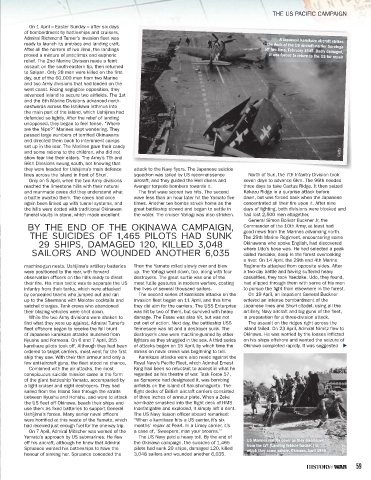
              Admiral Richmond Turner’s invasion fl eet was                                              A Japanese kamikaze aircraft strikes
              ready to launch its amtracs and landing craft.                                        the deck of the US aircraft-carrier Saratoga
              After all the horrors of Iwo Jima, the landings                                      off Iwo Jima, February 1945. Badly damaged,
              proved a mixture of anticlimax and euphoric                                           it was forced to return to the US for repair
              relief. The 2nd Marine Division made a feint
              assault on the south-eastern tip, then returned
              to Saipan. Only 28 men were killed on the fi rst
              day, out of the 60,000 men from two Marine
              and two Army divisions that had landed on the
              west coast. Facing negligible opposition, they
              advanced inland to secure two airfi elds. The 1st
              and the 6th Marine Divisions advanced north-
              eastwards across the Ishikawa Isthmus into
              the main part of the island, which Ushijima had
              defended so lightly. After the relief of landing
              unopposed, they began to feel tense. “Where
              are the Nips?” Marines kept wondering. They
              passed large numbers of terrifi ed Okinawans
              and directed them back to internment camps
              set up in the rear. The Marines gave their candy
              and some rations to the children, who did not                                                                  Getty
              show fear like their elders. The Army’s 7th and
              96th Divisions swung south, not knowing that
              they were headed for Ushijima’s main defence   attack to the Navy fl yers. The Japanese suicide
              lines across the island in front of Shuri.  squadron was tailed by US reconnaissance   North of Suri, the 7th Infantry Division took
                Only on 5 April, when the two Army divisions   aircraft, and they guided the Hell divers and   seven days to advance 6km. The 96th needed
              reached the limestone hills with their natural   Avenger torpedo bombers towards it.  three days to take Cactus Ridge. It then seized
              and manmade caves did they understand what   The fi rst wave scored two hits. The second   Kakazu Ridge in a surprise attack before
              a battle awaited them. The caves had once   wave less than an hour later hit the Yamato fi ve   dawn, but was forced back when the Japanese
              again been linked up with tunnel systems, and   times. Another ten bombs struck home as the   concentrated all their fi re upon it. After nine
              the hills were dotted with traditional Okinawan   great battleship slowed and began to settle in   days of fi ghting, both divisions were blocked and
              funeral vaults in stone, which made excellent   the water. The cruiser Yahagi was also stricken.   had lost 2,500 men altogether.
                                                                                             General Simon Bolivar Buckner Jr, the
               BY THE END OF THE OKINAWA CAMPAIGN,                                         Commander of the 10th Army, at least had
                                                                                           good news from the Marines advancing north.
                THE SUICIDES OF 1,465 PILOTS HAD SUNK                                      The 29th Marine Regiment, encountering some
                   29 SHIPS, DAMAGED 120, KILLED 3,048                                     Okinawans who spoke English, had discovered
                                                                                           where Udo’s base was. He had selected a peak
                 SAILORS AND WOUNDED ANOTHER 6,035                                         called Yaedake, deep in the forest overlooking
                                                                                           a river. On 14 April, the 29th and 4th Marine
              machine-gun nests. Ushijima’s artillery batteries   Then the Yamato rolled slowly over and blew   Regiments attacked from opposite sides. After
              were positioned to the rear, with forward   up. The Yahagi went down, too, along with four   a two-day battle and having suffered heavy
              observation offi cers on the hills ready to direct   destroyers. The great sortie was one of the   casualties, they took Yaedake. Udo, they found,
              their fi re. His main tactic was to separate the US   most futile gestures in modern warfare, costing   had slipped through them with some of his men
              infantry from their tanks, which were attacked   the lives of several thousand sailors.  to pursue the fi ght from elsewhere in the forest.
              by concealed teams who jumped out and ran   The second series of kamikaze attacks on the   On 19 April, an impatient General Buckner
              up to the Shermans with Molotov cocktails and   invasion fl eet began on 11 April, and this time   ordered an intense bombardment of the
              satchel charges. Tank crews who abandoned   they did aim for the carriers. The USS Enterprise   Japanese lines and Shuri citadel, using all the
              their blazing vehicles were shot down.  was hit by two of them, but survived with heavy   artillery, Navy aircraft and big guns of the fl eet,
                While the two Army divisions were shaken to   damage. The Essex was also hit, but was not   in preparation for a three-division attack.
              fi nd what they were up against, Admiral Turner’s   put out of action. Next day, the battleship USS   The assault on the ridges right across the
              fl eet offshore began to receive the full brunt   Tennessee was hit and a destroyer sunk. The   island failed. On 23 April, Admiral Nimitz fl ew to
              of Japanese kamikaze attacks launched from   destroyer’s crew were machine-gunned by other   Okinawa. He was worried by the losses infl icted
              Kyushu and Formosa. On 6 and 7 April, 355   fi ghters as they struggled in the sea. A third series   on his ships offshore and wanted the seizure of
              kamikaze pilots took off. Although they had been   of attacks began on 15 April, by which time the   Okinawa completed rapidly. It was suggested
              ordered to target carriers, most went for the fi rst   stress on naval crews was beginning to tell.
              ship they saw. With their thin armour and only a   Kamikaze attacks were also made against the
              few anti-aircraft guns, the fl eet stood no chance.  Royal Navy’s Pacifi c Fleet, which Admiral Ernest
                Combined with the air attacks, the most   King had been so reluctant to accept in what he
              conspicuous suicide mission came in the form   regarded as his theatre of war. Task Force 57,
              of the giant battleship Yamato, accompanied by   as Spruance had designated it, was bombing
              a light cruiser and eight destroyers. They had   airfi elds on the island of Sakishimagunto. The
              sailed from the Inland Sea through the straits   fl ight decks of British aircraft carriers consisted
              between Kyushu and Honshu, and were to attack   of three inches of armour plate. When a Zeke
              the US fl eet off Okinawa, beach their ships and   kamikaze smashed into the fl ight deck of HMS
              use them as fi xed batteries to support General   Indefatigable and exploded, it simply left a dent.
              Ushijima’s forces. Many senior naval offi cers   The US Navy liaison offi cer aboard remarked:
              were horrifi ed at this waste of the Yamato, which   “When a kamikaze hits a US carrier, it’s six
              had received just enough fuel for the one-way trip.  months’ repair at Pearl. In a Limey carrier, it’s
                On 7 April, Admiral Mitscher was warned of the   a case of, ‘Sweepers, man your brooms.’”
              Yamato’s approach by US submarines. He fl ew   The US Navy paid a heavy toll. By the end of
              off his aircraft, although he knew that Admiral   the Okinawa campaign, the suicides of 1,465   US Marines run for cover as they disembark
                                                                                            from the LVT (Landing Vehicle Tracked) in
              Spruance wanted his battleships to have the   pilots had sunk 29 ships, damaged 120, killed   which they came ashore, Okinawa, April 1945  Getty
              honour of sinking her. Spruance conceded the   3,048 sailors and wounded another 6,035.
                                                                                                                 HISTORY  WAR    59
                                                                                                                          of


        HoW01.Pacific invasion.indd   59                                                                                     30/01/2014   14:02

