


Page 83 - Forbes - USA (March 2020)
P. 83
SPECIAL ADVERTISING SECTION


           A MAN FOR ALL SEASONINGS


           Few executives anywhere have seen as many economic cycles as the head of the world’s best-known maker
           and purveyor of soy sauce and other global seasonings.


                                                                                                         something, the human perspective, you can’t
                                                                                                         really understand anything in business today.”
                                                                                                           His most incisive comments were about
                                                                                                         rapid change, risk and middle managers’
                                                                                                         inability to deal with both: “One thing I notice
                                                                                                         is the increasing pace of change. Of course,
                                                                                                         there is change in any era. But now the busi-
                                                                                                         ness cycles are much faster. There is greater
                                                                                                         pressure for companies to make changes
                                                                                                         quickly. Management must adapt. However,
                                                                                                         today’s middle managers have never experi-
                                                                                                         enced a period of strong economic growth.
                                                                                                         To use another sports analogy, they’ve never
                                                                                                         been on a winning team, so they don’t know
                                                                                                         how to win.”
                                                                                                           “In fact, top management isn’t much bet-
                                                                                                         ter—in many cases senior executives are just
                                                                                                         as risk-averse as middle managers, afraid to
           He’s not as young as he used to be, but he still   assets to work, perhaps by having older work-  invest even when doing so is necessary for
           cuts a dapper figure in person. At 84, he is one   ers teach younger ones, is a smart policy. It’s   a company’s growth. Simply put, people are
           of the elder statesmen of Japanese business,   good for the company, good for the workers     afraid of risk," he says.
           not merely by virtue of age, but due to the    and good for society. Everyone wins.”
           widespread respect he commands both at           Regarding Japan’s labor shortage he says,
           home and abroad.                               “The short-term answer is simple: we must         What should be done? Mogi replies
              Yuzaburo Mogi, the Honorary CEO and         make the best possible use of our existing        quickly that “both employees and
           Chairman of the Board of Kikkoman Corpora-     resources. That means providing better work-      managers should be given a wider
           tion, is in many ways the face of the company.   ing opportunities for both seniors and for      range of experiences to broaden
           Back in the early 1970s, he pushed the tradi-  women.”                                           their outlook.”
           tional soy sauce maker to set up a factory in    Many Japanese companies are now putting            Bold, decisive men such as Mogi
           the U.S.—years before Japan’s giant electron-  a strong emphasis on hiring employees with        helped to build Japan into the eco-
           ics companies and automakers did the same.     IT or technical skills. As Kikkoman is deeply     nomic giant it became in the 1970s
           His strategy of local manufacturing, local sales   involved in biotechnology, does Mogi share    and beyond. To continue growing in
           and responding to local needs was decades      that emphasis on technical expertise and IT       this century, the nation needs more
           ahead of its time.                             skills?                                           leaders with his values, insight and
              How does this farsighted executive feel       He thinks a moment and replies, “Of course,     vision.
           about changes in Japan today? For example,     IT skills are important today, but for most work-
           many Japanese companies set 60 as their        ers, they’re only a tool. Business is fundamen-
           mandatory retirement age, but are now hik-     tally about people, not technology. To succeed
           ing it to 65 in response to the growing labor   in business you must understand people.”
           shortage. How does Mogi see that change?         “I hear some executives say that history, lit-
              He is quick to respond: “There are lots of   erature, philosophy and so on have no value
           people who are still vigorous and want to      in the business world. I disagree. I believe
           work until 70 or even 75. Why should they be   our education system is too specialized; it
           forced to retire? Older workers have a wealth   has forgotten the importance of liberal arts.
           of knowledge and experience. Putting those     If you don’t understand the background of


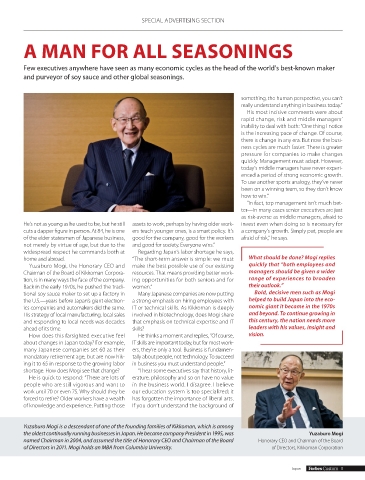
           Yuzaburo Mogi is a descendant of one of the founding families of Kikkoman, which is among
           the oldest continually running businesses in Japan. He became company President in 1995, was                               Yuzaburo Mogi
           named Chairman in 2004, and assumed the title of Honorary CEO and Chairman of the Board              Honorary CEO and Chairman of the Board
           of Directors in 2011. Mogi holds an MBA from Columbia University.                                          of Directors, Kikkoman Corporation


                                                                                                                               Japan                5

