


Page 232 - (DK Eyewitness) Travel Guide - The Netherlands
P. 232
230 WESTERN NE THERLANDS
7 Street-by-Street: Delft
Delft dates back to 1075, its prosperity based on the
weaving and brewing industries. In October 1654, however,
an enormous explosion at the national arsenal destroyed
much of the medieval town. The centre was rebuilt at the
end of the 17th century and has remained relatively
unchanged since then – houses in Gothic and Renaissance
styles still stand along the tree-lined canals. Town life is
concentrated on the Markt, which has the town hall at one
end and the Nieuwe Kerk at the other. Visitors can dip into
the scores of shops selling expensive, hand-painted
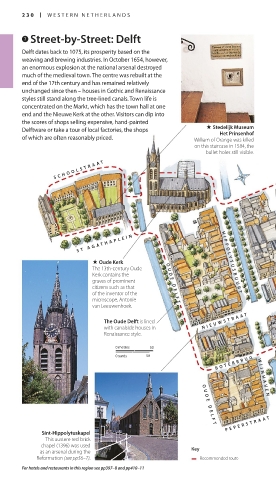
Delftware or take a tour of local factories, the shops . Stedelijk Museum
Het Prinsenhof
of which are often reasonably priced. William of Orange was killed
on this staircase in 1584, the
bullet holes still visible.
S C H O O L S T R A A T
S T A G A T H A P L E I N H P P P A P E N
I
O
S
T
L Y
. Oude Kerk O T R
The 13th-century Oude U U A
S
Kerk contains the D B A T
graves of prominent E U U
citizens such as that D R
of the inventor of the E T C A M E R E T T E N
L
microscope, Antonie F
T
van Leeuwenhoek.
The Oude Delft is lined N I E U W S T R A A T
with canalside houses in
Renaissance style.
0 metres 50
0 yards 50
B O T E R B R U G W I J N A
H
O
E
U
D
E
E V N
D
P E P E R S T R A A T
L
F
T
Sint-Hippolytuskapel
This austere red-brick
chapel (1396) was used
as an arsenal during the Key
Reformation (see pp56–7). Recommended route
For hotels and restaurants in this region see pp397–8 and pp410–11
230-231_EW_Netherlands.indd 230 16/01/17 11:54 am

