


Page 440 - (DK Eyewitness) Travel Guide - The Netherlands
P. 440
438 SUR VIV AL GUIDE
Banking and Local Currency
In the Netherlands, cash remains a popular means of
payment, but credit cards and debit cards are now the norm.
Almost all hotels, shops and restaurants accept major credit
cards in payment. Other means of payment are traveller’s
cheques (with identification), and, occasionally, US dollars
(particularly at antique and souvenir shops). In 2002, the
Netherlands began to use the euro. The best place to change
money is at a bank. You can take an unlimited amount of
currency into the Netherlands, and you can withdraw limited
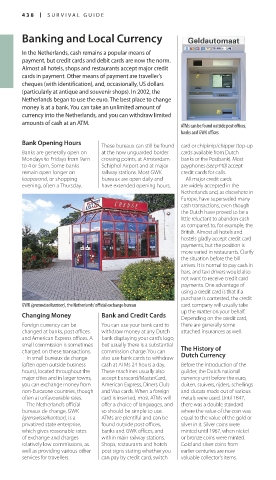
amounts of cash at an ATM. ATMs can be found outside post offices,
banks and GWK offices
Bank Opening Hours These bureaux can still be found card or chipknip/chipper (top-up
Banks are generally open on at the now unguarded border cards available from Dutch
Mondays to Fridays from 9am crossing points, at Amsterdam banks or the Postbank). Most
to 4 or 5pm. Some banks Schiphol Airport and at major payphones (see p440) accept
remain open longer on railway stations. Most GWK credit cards for calls.
koopavond, or shopping bureaux are open daily and All major credit cards
evening, often a Thursday. have extended opening hours. are widely accepted in the
Netherlands and, as elsewhere in
Europe, have superseded many
cash transactions, even though
the Dutch have proved to be a
little reluctant to abandon cash
as compared to, for example, the
British. Almost all hotels and
hostels gladly accept credit card
payments, but the position is
more varied in restaurants. Clarify
the situation before the bill
arrives. It is normal to pay cash in
bars, and taxi drivers would also
not want to receive credit card
payments. One advantage of
using a credit card is that if a
purchase is contested, the credit
GWK (grenswisselkantoor), the Netherlands’ official exchange bureau card company will usually take
up the matter on your behalf.
Changing Money Bank and Credit Cards Depending on the credit card,
Foreign currency can be You can use your bank card to there are generally some
changed at banks, post offices withdraw money at any Dutch attached insurances as well.
and American Express offices. A bank displaying your card’s logo,
small commission is sometimes but usually there is a substantial
charged on these transactions. commission charge. You can The History of
Dutch Currency
In small bureaux de change also use bank cards to withdraw
(often open outside business cash at ATMs 24 hours a day. Before the introduction of the
hours), located throughout the These machines usually also guilder, the Dutch national
major cities and in larger towns, accept Eurocard/MasterCard, currency unit before the euro,
you can exchange money from American Express, Diners Club duiten, stuivers, rijders, schellings
non-Eurozone countries, though and Visa cards. When a foreign and ducats made out of various
often at unfavourable rates. card is inserted, most ATMs will metals were used. Until 1847,
The Netherland’s official offer a choice of languages, and there was a double standard
bureaux de change, GWK so should be simple to use. where the value of the coin was
(grenswisselkantoor), is a ATMs are plentiful and can be equal to the value of the gold or
privatized state enterprise, found outside post offices, silver in it. Silver coins were
which gives reasonable rates banks and GWK offices, and minted until 1967, when nickel
of exchange and charges within main railway stations. or bronze coins were minted.
relatively low commissions, as Shops, restaurants and hotels Gold and silver coins from
well as providing various other post signs stating whether you earlier centuries are now
services for travellers. can pay by credit card, switch valuable collector’s items.
438-439_EW_Netherlands.indd 438 16/01/17 12:08 pm

