


Page 71 - (DK Eyewitness) Travel Guide - The Netherlands
P. 71
INTRODUCING A MSTERD A M 69
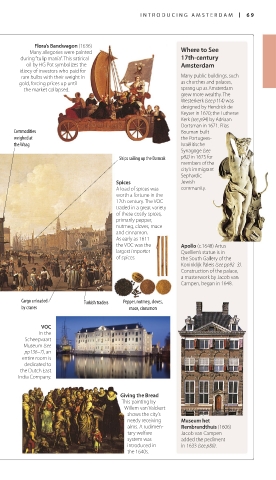
Flora’s Bandwagon (1636)
Many allegories were painted Where to See
during “tulip mania”. This satirical 17th-century
oil by HG Pot symbolizes the Amsterdam
idiocy of investors who paid for
rare bulbs with their weight in Many public buildings, such
gold, forcing prices up until as churches and palaces,
the market collapsed. sprang up as Amsterdam
grew more wealthy. The
Westerkerk (see p114) was
designed by Hendrick de
Keyser in 1620; the Lutherse
Kerk (see p94) by Adriaan
Dortsman in 1671. Elias
Commodities Bouman built
weighed at the Portugees
the Waag Israëlitische
Synagoge (see
Ships sailing up the Damrak p82) in 1675 for
members of the
city’s immigrant
Sephardic
Spices Jewish
A load of spices was community.
worth a fortune in the
17th century. The VOC
traded in a great variety
of these costly spices,
pri marily pepper,
nutmeg, cloves, mace
and cinnamon.
As early as 1611
the VOC was the Apollo (c.1648) Artus
largest importer Quellien’s statue is in
of spices. the South Gallery of the
Koninklijk Paleis (see pp92–3).
Construction of the palace,
a masterwork by Jacob van
Campen, began in 1648.
Cargo unloaded Turkish traders Pepper, nutmeg, cloves,
by cranes mace, cinnamon
VOC
In the
Scheepvaart
Museum (see
pp136–7), an
entire room is
dedicated to
the Dutch East
India Company.
Giving the Bread
This painting by
Willem van Valckert
shows the city’s
needy receiving Museum het
alms. A rudimen Rembrandthuis (1606)
tary welfare Jacob van Campen
system was added the pediment
introduced in in 1633 (see p80).
the 1640s.
068-069_EW_Netherlands.indd 69 16/01/17 12:03 pm

