


Page 18 - (DK Eyewitness) Back Roads Travel Guide - France
P. 18
16  BACK ROADS FRANCE

       Driving in France

       France has one of the densest road networks in Europe, with
       modern motorways allowing quick and easy access to all parts
       of the country. However, it is only by driving the back roads that
       you will discover the real France. This will, of course, mean
       tackling anything from roundabouts and road signs to herds of
       sheep in your path. To get the most from your travels, and to do
       so safely, it is essential to familiarize yourself with the rules and
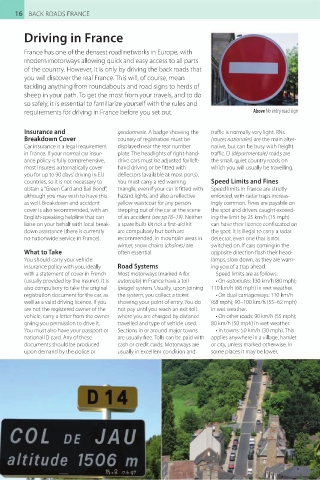
       requirements for driving in France before you set out.     Above No entry road sign

       Insurance and           gendarmerie. A badge showing the   traffic is normally very light. RNs
       Breakdown Cover         country of registration must be   (routes nationales) are the main alter-
       Car insurance is a legal requirement   displayed near the rear number   native, but can be busy with freight
       in France. If your normal car insur-  plate. The headlights of right-hand-  traffic. D (départmentale) roads are
       ance policy is fully comprehensive,   drive cars must be adjusted for left-  the small, quiet country roads on
       most insurers automatically cover   hand driving or be fitted with   which you will usually be travelling.
       you for up to 90 days’ driving in EU   deflectors (available at most ports).
       countries, so it is not necessary to   You must carry a red warning   Speed Limits and Fines
       obtain a “Green Card and Bail Bond”,   triangle, even if your car is fitted with   Speed limits in France are strictly
       although you may wish to have this   hazard lights, and also a reflective   enforced, with radar traps increas-
       as well. Breakdown and accident   yellow waist coat for any person   ingly common. Fines are payable on
       cover is also recommended, with an   stepping out of the car at the scene   the spot and drivers caught exceed-
       English-speaking helpline that can   of an accident (see pp18–19). Neither    ing the limit by 25 km/h (15 mph)
       liaise on your behalf with local break-  a spare bulb kit nor a first-aid kit    can have their licence confiscated on
       down assistance (there is currently   are compulsory but both are   the spot. It is illegal to carry a radar
       no nationwide service in France).  recommended. In mountain areas in   detector, even one that is not
                               winter, snow chains (chaînes) are   switched on. If cars coming in the
       What to Take            often essential.        opposite direction flash their head-
       You should carry your vehicle                   lamps, slow down, as they are warn-
       insurance policy with you, ideally   Road Systems  ing you of a trap ahead.
       with a statement of cover in French   Most motorways (marked A for   Speed limits are as follows:
       (usually provided by the insurer). It is   autoroute) in France have a toll   • On autoroutes: 130 km/h (80 mph);
       also compulsory to take the original   (péage) system. Usually, upon joining   110 km/h (68 mph) in wet weather.
       registration document for the car, as   the system, you collect a ticket   • On dual carriageways: 110 km/h
       well as a valid driving licence. If you   showing your point of entry. You do   (68 mph); 90–100 km/h (55–62 mph)
       are not the registered owner of the   not pay until you reach an exit toll,   in wet weather.
       vehicle, carry a letter from the owner   where you are charged by distance   • On other roads: 90 km/h (55 mph);
       giving you permission to drive it.    travelled and type of vehicle used.   80 km/h (50 mph) in wet weather.
       You must also have your passport or   Sections in or around major towns   • In towns: 50 km/h (30 mph). This
       national ID card. Any of these   are usually free. Tolls can be paid with  applies anywhere in a village, hamlet
       documents should be produced   cash or credit cards. Motorways are   or city, unless marked otherwise. In
       upon demand by the police or   usually in excellent condition and   some places it may be lower.

