


Page 9 - (DK Eyewitness) Travel Guide - Milan & The Lakes
P. 9
HOW T O USE THIS GUIDE 7
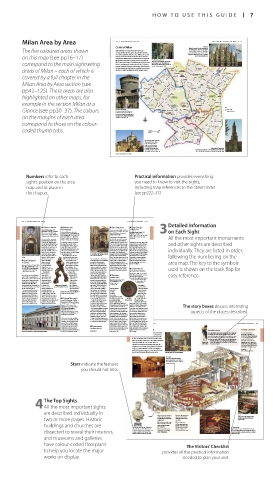
Milan Area by Area 16 INTRODUCING MILAN PUT TING MILAN ON THE M AP 17
Duomo
Central Milan Milan’s Lombard-Gothic cathedral is
The five coloured areas shown Although Milan is a major city in all respects, it is the third largest church in the world
and took four centuries to finish. On
comparatively small. The city has been divided into five
top is the Madonnina, a statue of the
Madonna that has become a symbol
on this map (see pp16–17) areas in this guide. The historic centre, which you can visit Via Montenapoleone of the city (see pp48–51).
on foot, takes in the Duomo and Teatro alla Scala; in the
northwestern district are the Castello Sforzesco and Santa
Maria delle Grazie, whose refectory houses Leonardo da
correspond to the main sightseeing Vinci’s famous Last Supper. Sant’Ambrogio and San Lorenzo This is the most famous street in the V I A U . B A S S I PIAZZALE VIA POLA
area known as the “Quadri lateral”,
VIA ALSERIO
lie in the southwest; the southeast boasts the Ca’ Granda,
LAGOSTA
where the leading fashion designers
now the university. The large northeastern district includes
are located (see pp108–109).
areas of Milan – each of which is the Brera quarter, with its famous art gallery, Corso Venezia V I A C E N I S I O Cenisio VIA L. NONO MONUMENTALE V I A C A R LO F A R I N IVIA CARLO FARINI V I A G . P E P E V I A B O R S I E R I
and the so-called Quadrilateral, with its designer shops.
Centrale
CIMITERO
V IA FABIO FILZI
Monumentale Stazione Porta Gioia DUCA D'AOSTA VI A A . D O R I A Caiazzo A I R E S
PIAZZA
covered by a full chapter in the CORSO VIA POLIZIANO V IA M US SI Gerusalemme V I A A L E AR DI V. PROCACCINI MONUMENTALE BAIAMONTI PIAZZALE Garibaldi VIA MELCHIORRE GIOIA V I A P I R E L L I VIA VITTOR PIS
VIA I N DUN O V I A TA RTA G L I A
PIAZZALE
VIA SETTEMBRINI VIA SETTEMBRINI
CIMITERO
PIAZZA
PROCACCINI
EINAUDI
C O R S O C O M O
V I A S C A R L AT T I
V I A
VIA PAOLO SARPI
Milan Area by Area section (see Portello VIALE DUILIO V. BOEZIO VIA Domodossola VIA VIA MOSCATI VIA CANONICA VIA ROSMINI VIA GIANNONE VIA MONTELLO BRAMANTE VI A FERRARI V I A L E LUIGI STUR Z O VI A
VIA SETTALA
VIALE CRISPI
V. GALILEI
PIAZZA
PRINC.
PIAZZA
CLOTILDE
DELLA
REPUBBLICA
VIA MASSENA
Repubblica
Moscova
pp42–125). These areas are also Tre Torri V I A L E D E L L ' I N D U S T R I A PIAZZA VI DOMODOSSOLA SEMPIONE CORSO SEMPIONE VIA CANOVA VIA MELZI D'ERIL VIA LEGNANO V I A D E L L A M O S C O V A VIA TURATI V I A
VIA VOLTA
FEBBRAIO
PIAZZA
VIA PALLAVICINO VIA R. S. CAVALLERIA
SEMPIONE
Turati
highlighted on other maps, for Amendola- GIULIO CESARE VIALE CASSIODORO VIA VINCENZO MONTI VIA VINCENZO MONTI SEMPIONE VIA PONTACCIO VIA FATEBENEFRATELLI VIA TURATI VIA GIARDINI PALESTRO OBERDAN PIAZZA
PUBBLICI
PARCO
Fiera
PIAZZALE
Pinacoteca
MANZONI
example in the section Milan at a V I A T I Z I A N O Buonarroti VIA MARIO PAGANO VIA M. PAGANO VIALE ZOLA Milano Cadorna FORO BUONAPARTE C O R S O G A R I B A L D I VIA MERCATO VIA
di Brera
Lanza
Montenapoleone
Stazione
Castello
Sforzesco
MOZART
VIA ROSSETTI VIA MASCHERONI
Glance (see pp30–37). The colours Castello Sforzesco Pagano VIA D'AREZZO Conciliazone CONCILIAZIONE delle Grazie S. Maria Cadorna Cairoli VIA DANTE La Scala Cordusio PIAZZA DELLA SCALA VIA A. S. Babila C O R S O VIA Major sight
PIAZZA
VIA BOCCACCIO
The Visconti built this fortress in
Pedestrian street
1368 and it was later rebuilt by
CORSO MAGENTA VIA MERAVIGLI
on the margins of each area the Sforza dynasty, creating one of VIA SAN VITTORE V I A C A R D U C C I Ambrosiana Duomo PIAZZA DEL DUOMO Duomo CORSO V. EMANUELE II V I A D U R I N I VIA VISC ONTI DI MO DRONE
Europe’s most elegant Renaissance
residences (see pp66–9).
Pinacoteca
correspond to those on the colour- VIA G.B. VICO S. Ambrogio Sant’Ambrogio VIA DE AMICIS VIA MAZZINI V I A L A R G A V I A S F O R Z A V I A S A N B A R N A B A V I A L E C A L D A R A V I A L E R E G . M A R
CO RSO POR TA VITTORIA
coded thumb tabs. 0 metres 0 yards 600 600 VIA ARIBERTO CORSO DI VIA CORRENTI San Lorenzo C O R S O I TA L I A V I A S A N TA S O F I A
Missori
alle Colonne
CORSO COLOMBO PORTA GENOVA VIA ARENA CORSO DI PORTA TICIN ESE VIA SANTA C RO CE VIA MOLINO D. ARMI CORSO DI PORTA ROMANA CORSO DI PORTA ROMANA
Crocetta
San Lorenzo alle Colonne VIA VIGEVANO A VLE. D'ANNUNZIO VIALE G. GALEAZZO CORSO ITALIA VIA G.MERCALLI VIA S. FRANC. D'ASSISI VIA BIANCA DI SAVOIA
VIA GORIZI
This church is one of the
Early Christian basilicas RI PA D I PORTA TI CIN ES E
built for Sant’Ambrogio
(St Ambrose) in the 4th
century. It is the only one Abbazia di Chiaravalle
that still preserves some of The abbey, founded in 1135 by Cistercian Benedictines,
its original parts (see pp82–3). lies 7 km (4 miles) southeast of Milan (see pp104–105).
For keys to symbols see back flap
Numbers refer to each Practical information provides everything
sight’s position on the area you need to know to visit the sights,
map and its place in including map references to the Street Finder
the chapter. (see pp222–35).
56 MILAN AREA B Y AREA HIST ORIC CENTRE 57
Detailed Information
0 Palazzo Reale q Museo del r San Sepolcro y San Giorgio
Piazza del Duomo. Map 7 C1. Novecento Piazza San Sepolcro. Map 7 B1. q 1, 3 al Palazzo
Tel 02-88 46 52 30. q 1, 3 Duomo. Palazzo dell’Arengario, Piazza del Duomo. v 1, 2, 14. Open noon–2pm Piazza San Giorgio 2. Map 7 B1. 3on Each Sight
v 1, 2, 3, 12, 24, 27. @ 54, 60. Duomo. Map 7 C1. Tel 02-88 44 40 72. Mon–Fri. 5 5pm pre-hols; noon Tel 02-805 71 48. v 2, 14.
Open 9:30am–7:30pm daily (from q 1, 3 Duomo. v 1, 2, 3, 12, 14, 24, 27. (winter), 5pm hols. ^ Open 7:30am–noon, 3:30–6pm daily.
2:30pm Mon, to 10:30pm Thu & Sat).
@ 54, 60. Open 2:30–7:30pm Mon, San Sepolcro was founded in 5 8am Mon–Fri; 6pm pre-hols; All the most important monuments
The seat of the commune 9:30am–7:30pm Tue, Wed, Fri & Sun, 1030 in the area of the ancient 11am hols.
9:30am–10:30pm Thu & Sat. & 7
administration in the 11th Roman Forum and rebuilt in
century, this building was Construction of the Arengario, 1100 at the time of the second Founded in 750, this church was
drastically rebuilt by Azzone designed by architect Piero Crusade. The Neo-Roman esque named after an ancient Roman and other sights are described
Visconti in 1330–36. At the Portaluppi and others, began façade was built in 1897, while palatium which stood here. It
height of its importance, it in the late 1930s as part of a the interior is basically Baroque. was radically changed in 1623
was the headquarters of modernisation plan for the city. There are two terracotta groups and 1800–21 by the architects individually. They are listed in order,
the lords of Milan. Galeazzo The name arengario refers to by Agostino De Fondutis (16th Richini and Cagnola respectively,
Maria Sforza’s decision to the place where medieval town century): Christ Washing His and little remains of the original
move the palace began councils were held. The well in Piazza Mercanti and, on the left, Disciples’ Feet and The Flagellation or Romanesque (1129) structures.
The entrance to the church of San Gottardo the decline of the Palazzo The building now houses Palazzo delle Scuole Palatine of Christ with Caia phas and St The third chapel in the right- following the numbering on the
in Corte Reale. In 1598 it housed the Museo del Novecento Peter. The only extant part of the hand aisle contains paintings
the first permanent (Museum of 20th-Century This courthouse is also known 1030 church is the Romanesque by Ber nardino Luini (1516)
9 San Gottardo theatre in Milan. Art). Architect Italo as “Broletto Nuovo” to distinguish crypt, with a sculpture group with scenes from the Passion.
in Corte Made of wood, Rota’s design includes it from the older Broletto of the Deposition by the De On the vault there is a fresco area map. The key to the symbols
an exterior steel and
Via Pecorari 2. Map 8 D1. Tel 02-86 46 it was rebuilt in glass bridge to con nect Vecchio near Palazzo Reale. Fondutis school in the apse. The of the Crucifixion.
1737 and Mozart
Markets were held under the
lower part of the church, the
45 00. q 1, 3 Duomo. v 3, 12, 15, played here as a the building to the porticoes, while the Salone dei Chiesa Inferiore San Sepolcro,
16, 24, 27. @ 54. Open 8am–noon, child. In 1776 it was Palazzo Reale, creating Giudici on the first floor was reopened in 2016 after being u Santa Maria used is shown on the back flap for
2– 6pm Mon–Fri (to 5:30pm Fri), destroyed by a fire. an important museum used as the law court. In 1773 closed for more than 50 years.
2– 4pm Sat, 8am–noon Sun. presso San Satiro
The present complex. The another storey was added to
Neo-Classical museum traces house the notarial archive. Via Speronari 3. Map 7 C1. Tel 02-87
Azzone Visconti, lord of Milan, appearance the history of On one side of the square is t Palazzo 46 83. q 1, 3 Duomo. v 1, 2, 3, 14, easy reference.
ordered the con struction of dates from 1778, 20th-century the Loggia degli Osii, built by Borromeo 16, 24, 27. @ 54. Open 7:30–
11:30am, 3:30–6:30pm Mon–Fri, 9am–
this church in 1336 as the ducal when Giuseppe Italian art, Matteo Visconti in 1316. The Piazza Borromeo 7. Map 4 D4. noon, 3:30–7pm Sat & Sun. 5
chapel in the Broletto Vecchio Piermarini made with sections façade is decorated with the q 1 Cordusio. v 1, 2, 3, 7:45am, 6pm Mon–Sat,
(Court house) courtyard. The it into a residence devoted to arms of the districts of Milan 14, 16, 27. Open 11am, 6pm Sun.
interior was rebuilt in Neo- for Archduke movements and statues of the Virgin Mary courtyard only.
Classical style by Piermarini. On Ferdinand of Unique forms of Continuity in like Futurism, and saints (1330). Next is the The original
the left-hand wall is a Crucifixion Austria. In 1920 Space (1913) by Umberto Boccioni Metaphysical Art, Palazzo delle Scuole Palatine nucleus of this
by the school of Giotto. Vittorio Emanuele III Arte Povera and (1645), the façade of which This prestigious church, founded
Azzone Visconti’s funerary granted the place Abstractionism. bears statues of St Augustine early 15th- by arch bishop
monument, by Giovanni di temporarily to the city Works by 20th-century Milanese and the Latin poet Ausonius. century Ansperto da
Balduccio, is in the apse: the of Milan, and in 1965 the artists are also featured. The Palazzo dei Panigarola (to residence Biassono, dates
reclining statue of Visconti is city purchased it to use as the right), which was rebuilt in was badly from 876. The
flanked by the figures of two offices and museums and the 15th century, was used to damaged by the 1943 only remnant is
women. The octagonal brick for important temporary w Piazza Mercanti register public documents. bombings and the only Santa Maria the Sacello della Pietà
bell tower with small stone exhibitions by sculptors and and Palazzo della In the centre of the square remaining original presso San Satiro (chapel of pity),
arches and columns is by painters such as Claude is a 16th-century well. In a archi tectural element which was altered by
Francesco Pecorari (c.1335). Monet and Pablo Picasso. Ragione Fotografia secluded corner of the square, is the ogival portal, with leaf Bramante in the 15th century,
Map 7 C1. q 1 Cordusio, 1 & 3 the Palazzo della Ragione decoration and the coat of arms and the Lombard Romanesque The story boxes discuss interesting
Duomo. v 1, 2, 3, 12, 14, 16, 24, 27. Fotografia occupies a historic of the Borromeo family. The bell tower. In 1478 Bramante
@ 54. Palazzo della Ragione 13th-century building. The space, partly rebuilt second court yard was asked to rebuild the church
Fotografia: Tel 02-43 35 35 35. now restored, hosts some of has porticoes on three sides to salvage a 13th-century fresco aspects of the places described.
Open 9:30am–8:30pm Tue–Sun (to the city’s best photography and on the fourth, between the on the façade, which was said
10:30pm Thu & Sat). 7 ∑ palazzo exhibitions. In Via Mercanti is brick windows, is the original to have miraculous powers.
dellaragionefotografia.it the Palazzo dei Giureconsulti, decoration with the family motto Bramante set it on the high
dominated by the Torre del Humilitas. This courtyard leads altar, solving the problem of
This corner of medieval Milan Comune, built by Napo Torriani to the 15th-century Sala dei lack of space by creating a sort
was the seat of public and civic in 1272. At the foot of this tower Giochi, which is decorated with of trompe l’oeil apse of only 97
activities and also housed the is a statue of Sant’Ambrogio. frescoes of the games played cm (38 in) with stuccowork and
prison. Palazzo della Ragione by the aristocracy of the time, frescoes. The transept leads to B Y AREA HIST ORIC CENTRE 55
54 MILAN AREA
was built in 1233 by the chief including the Game of Tarot. The the Chapel of San Satiro with a
magistrate (and virtual ruler) e Pinacoteca red background developed as terracotta Pietà (c.1482). In the
Oldrado da Tresseno, who is Ambrosiana the result of a chemical reaction right-hand aisle is the octagonal
3 Teatro alla Scala
portrayed in a relief by Ante lami which changed the original baptismal font decorated by VISITORS’ CHECKLIST
Palazzo Reale, now used as a venue for temporary exhibitions on the side facing the square. See pp58–61. blue of the sky De Fondutis. The Ballet School
Built by Giuseppe Piermarini in 1776-8, this opera La Scala’s Ballet School was founded in 1813. Originally Practical Information
house owes its name to the fact that it stands on there were 48 students who studied dance, mime or Piazza della Scala. Map 3 C5.
the site of Santa Maria della Scala, a church built the best students were awarded merits of distinction Scala: Largo Ghiringhelli 1 (Piazza
Tel 02-88 791. Museo Teatrale alla
specialist disciplines. At the end of an eight-year course,
in 1381 for Regina della Scala, Bernabò Visconti’s and became part of the theatre’s corps de ballet with an Scala). Tel 02-88 79 74 73.
wife. The theatre opened in 1778; it was bombed in annual stipend of €1.5. This rigorously disciplined Open 9am–noon, 1:30–5pm
1943 and rebuilt three years later. After an Students at the school has produced such artists as Carla Fracci and daily. & (includes a look at the
extensive restoration pro gramme that saw the Ballet School Luciana Savignano. theatre from a balcony, provided
there are no rehearsals or shows).
addition of a new stage tower designed by Mario 7 = ∑ teatroallascala.org
Botta, La Scala reopened in 2004. The opening Transport
night of the opera season is 7 December, the feast q 1, 3 Duomo. v 1, 61.
day of Sant’Ambrogio, Milan’s patron saint. Teatro alla Scala in 1852, by Angelo Inganni
. Foyer
This large, mirror-lined salon
was renovated in 1936. There is a
Stars indicate the features bust of the legendary conductor
Arturo Toscanini.
you should not miss.
The Top Sights
4All the most important sights
are described individually in Entrance KEY 1 The façade was designed 4 A tank, filled with water, Stage
This is one of the largest stages
two or more pages. Historic by Piermarini so that passers- placed over the wooden in Italy, measuring 1,200 sq m
vault, was ready for use in
by in Via Manzoni could catch
case of fire.
a glimpse of it.
(13,000 sq ft).
5 Dressing rooms
2 The boxes were like small
buildings and churches are . Museo Teatrale living rooms where romantic 6 The orchestra pit was . Auditorium
trysts and parlour games
introduced in 1907. Before
were arranged.
The theatre museum was founded in
then the orchestra played
Made of wood covered with red velvet and
dissected to reveal their interiors. sculpture, original scores, paintings and of Bohemian crystal (1923), the same level as the stalls. decorated with gilded stuccowork, the interior
behind a balustrade on
1913 and boasts a fine collection of
3 The chandelier, made
holds 383 lightbulbs.
boasts marvellous acoustics and has a seating
ceramics related to the history of La
capacity of 2,015.
Scala as well as of theatre in general.
and museums and galleries
have colour-coded floorplans The Visitors’ Checklist
to help you locate the major provides all the practical information
works on display. needed to plan your visit.
006-007_EW_Milan.indd 7 20/10/16 3:15 pm

