


Page 32 - (DK Eyewitness) Top 10 Travel Guide - Tokyo
P. 32
30  ❯❯  Top 10 Tokyo Highlights

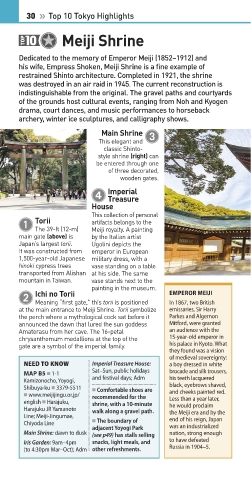
               Meiji Shrine

     Dedicated to the memory of Emperor Meiji (1852–1912) and
     his wife, Empress Shoken, Meiji Shrine is a fine example of
     restrained Shinto architecture. Completed in 1921, the shrine
     was destroyed in an air raid in 1945. The current reconstruction is
     indis tinguishable from the original. The gravel paths and courtyards
     of the grounds host cultural events, ranging from Noh and Kyogen
     drama, court dances, and music performances to horseback
     archery, winter ice sculptures, and calligraphy shows.
                        Main Shrine 3
                       This elegant and
                        classic Shinto-
                       style shrine (right) can
                       be entered through one
                         of three decorated,
                            wooden gates.
                         Imperial
                      4
                         Treasure
                      House
                      This collection of personal
         Torii
     1                artifacts belongs to the
         The 39-ft (12-m)
                      Meiji royalty. A painting
     main gate (above) is   by the Italian artist
     Japan’s largest torii.    Ugolini depicts the
     It was constructed from   emperor in European
     1,500-year-old Japanese  military dress, with a
     hinoki cypress trees   vase standing on a table
     transported from Alishan  at his side. The same
     mountain in Taiwan.   vase stands next to the
                      painting in the museum.
         Ichi no Torii
     2                                 EMPEROR MEIJI
         Meaning “first gate,” this torii is positioned
                                       In 1867, two British
     at the main entrance to Meiji Shrine. Torii symbolize   emissaries, Sir Harry
     the perch where a mytholo gical cock sat before it   Parkes and Algernon
     anno unced the dawn that lured the sun goddess   Mitford, were granted
     Amaterasu from her cave. The 16-petal    an audience with the
     chrysan themum medallions at the top of the    15-year-old emperor in
     gate are a symbol of the imperial family.  his palace in Kyoto. What
                                       they found was a vision
                                       of medieval sovereignty:
      NEED TO KNOW    Imperial Treasure House:   a boy dressed in white
      MAP B5  •  1-1   Sat–Sun, public holidays   brocade and silk trousers,
      Kamizonocho, Yoyogi,   and festival days; Adm   his teeth lacquered
      Shibuya-ku  •  3379-5511    •  Comfortable shoes are   black, eyebrows shaved,
      •  www.meijijingu.or.jp/  recommended for the   and cheeks painted red.
      english  •  Harajuku,   shrine, with a 10-minute   Less than a year later,
      Harajuku JR Yamanote    walk along a gravel path.  he would proclaim
                                       the Meiji era and by the
      Line; Meiji-Jingumae,   •  The boundary of   end of his reign, Japan
      Chiyoda Line
                      adjacent Yoyogi Park    was an industrialized
      Main Shrine: dawn to dusk  (see p49) has stalls selling   nation, strong enough
      Iris Garden: 9am–4pm    snacks, light meals, and   to have defeated
      (to 4:30pm Mar–Oct); Adm other refreshments.  Russia in 1904–5.


 030-031_Top_10_Tokyo.indd   30                       15/11/2016   12:25

