


Page 178 - (DK Eyewitness) Travel Guide - France
P. 178
3 "'\-=
CHÂTEAU DE
FONTAINEBLEAU
EXPERIENCE Île-de-France gardens: 9am–5pm daily (to 6pm Mar, Apr & Oct; to 7pm May–Sep)
! E3 ⌂ Seine-et-Marne # Château: 9:30am–5pm Wed–Mon (to 6pm Apr–Sep);
∑ chateaudefontainebleau.fr
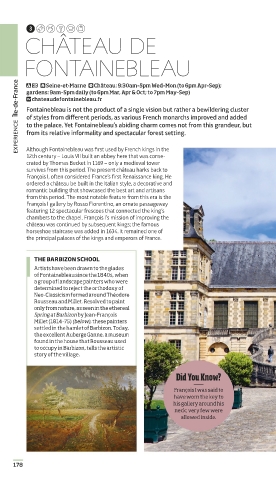
Fontainebleau is not the product of a single vision but rather a bewildering cluster
of styles from different periods, as various French monarchs improved and added
to the palace. Yet Fontainebleau’s abiding charm comes not from this grandeur, but
from its relative informality and spectacular forest setting.
Although Fontainebleau was first used by French kings in the
12th century – Louis VII built an abbey here that was conse
crated by Thomas Becket in 1169 – only a medieval tower
survives from this period. The present chât eau harks back to
François I, often considered France’s first Renaissance king. He
ordered a chât eau be built in the Italian style, a decorative and
romantic building that showcased the best art and artisans
from this period. The most notable feature from this era is the
François I gallery by Rosso Fiorentino, an ornate passageway
featuring 12 spectacular frescoes that connected the king’s
chambers to the chapel. François I’s mission of improving the
chât eau was continued by subsequent kings; the famous
horseshoe staircase was added in 1634. It remained one of
the principal palaces of the kings and emperors of France.
THE BARBIZON SCHOOL
Artists have been drawn to the glades
of Fontainebleau since the 1840s, when
a group of landscape painters who were
determined to reject the orthodoxy of
Neo-Classicism formed around Théodore
Rousseau and Millet. Resolved to paint
only from nature, as seen in the ethereal
Spring at Barbizon by Jean-François
Millet (1814–75) (below), these painters
settled in the hamlet of Barbizon. Today,
the excellent Auberge Ganne, a museum
found in the house that Rousseau used
to occupy in Barbizon, tells the artistic
story of the village.
Did You Know?
François I was said to
have worn the key to
his gallery around his
neck; very few were
allowed inside.
178
178-179_EW_France.indd 178 29/01/2019 17:02
EW Must-see template v2.1 – 18th October 2018
Fonts: Aptifer Sans LT Pro, Posterama Text, Soho Gothic
Pro, Soho Pro, ITC Caslon 224

