


Page 301 - (DK Eyewitness) Travel Guide - France
P. 301
It boasts beautifully carved
       capitals and an immense nave
       with four domes, one of the
       finest examples of a cupola
       nave in France.
         The abbey’s nuns lived
       around the Renaissance Grand
       Moûtier cloisters, forming one
       of the largest nunneries in
       France. The leper colony was
       once housed in the St-Lazare
       priory, now a hotel and restau-
       rant. Most impressive is the
       octagonal kitchen with its fire-
       places and chimneys in the
       Tour Evraud, a rare example
       of secu lar Romanesque archi-
       tecture. The abbey is now an
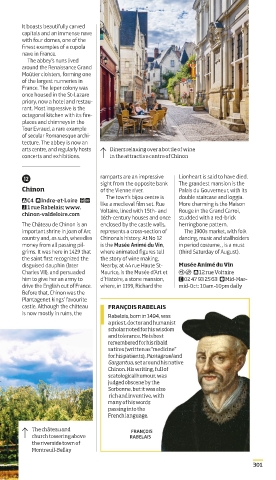
       arts centre, and regularly hosts   Diners relaxing over a bottle of wine
       concerts and exhibitions.  in the attractive centre of Chinon


       12                  ramparts are an impressive   Lionheart is said to have died.
                           sight from the opposite bank
                                               The grandest mansion is the
       Chinon              of the Vienne river.   Palais du Gouverneur, with its
                             The town’s bijou centre is   double staircase and loggia.
       ! C4   ⌂ Indre-et-Loire   £ @
       n 1 rue Rabelais; www.  like a medieval film set. Rue   More charming is the Maison
       chinon-valdeloire.com  Voltaire, lined with 15th- and   Rouge in the Grand Carroi,
                           16th-century houses and once   studded with a red-brick
       The Château de Chinon is an   enclosed by the castle walls,   herringbone pattern.
       important shrine in Joan of Arc   repre sents a cross-section of     The 1900s market, with folk
       country and, as such, wheedles  Chinonais history. At No 12     dancing, music and stall holders
       money from all passing pil-  is the Musée Animé du Vin,   in period costume, , is a must
       grims. It was here in 1429 that   where animated figures tell   (third Saturday of August).
       the saint first recognized the   the story of wine making.
       disguised dauphin (later   Nearby, at 44 rue Haute St-  Musée Animé du Vin
       Charles VII), and persuaded   Maurice, is the Musée d’Art et   ' "   ⌂ 12 rue Voltaire
       him to give her an army to   d’Histoire, a stone mansion,   § 02 47 93 25 63   # Mid-Mar–
       drive the English out of France.   where, in 1199, Richard the   mid-Oct: 10am–10pm daily
       Before that, Chinon was the
       Plantagenet kings’ favourite
       castle. Although the château     FRANÇOIS RABELAIS
       is now mostly in ruins, the   Rabelais, born in 1494, was
                             a priest, doctor and huma nist
                             scholar noted for his wisdom
                             and tolerance. He is best
                             remembered for his ribald
                             satires (written as “medicine”
                             for his patients), Pantagruel and
                             Gargantua, set around his native
                             Chinon. His writing, full of
                             scatological humour, was
                             judged obscene by the
                             Sorbonne, but it was also
                              rich and inventive, with
                             many of his words
                             passing into the
                             French language.
         The château and           FRANÇOIS
         church towering above    RABELAIS
         the riverside town of
         Montreuil-Bellay
                                                                  301


   300-301_EW_France.indd   301                              30/01/2019   16:44

