


Page 313 - (DK Eyewitness) Travel Guide - France
P. 313
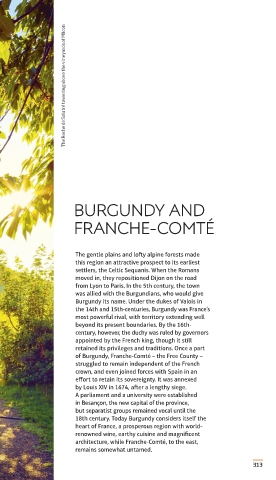
The Roche de Solutré towering above the vineyards of Mâcon


                      BURGUNDY AND

                     FRANCHE-COMTÉ


                    The gentle plains and lofty alpine forests made
                    this region an attractive prospect to its earliest
                    settlers, the Celtic Sequanis. When the Romans
                    moved in, they repositioned Dijon on the road
                    from Lyon to Paris. In the 5th century, the town
                    was allied with the Burgundians, who would give
                    Burgundy its name. Under the dukes of Valois in
                    the 14th and 15th-centuries, Burgundy was France’s
                    most power ful rival, with territory extending well
                    beyond its present boundaries. By the 16th-
                    century, however, the duchy was ruled by governors
                    appointed by the French king, though it still
                    retained its privileges and traditions. Once a part
                    of Burgundy, Franche-Comté – the Free County –
                    struggled to remain independent of the French
                    crown, and even joined forces with Spain in an
                    effort to retain its sover eignty. It was annexed
                    by Louis XIV in 1674, after a lengthy siege.
                    A parliament and a university were established
                    in Besançon, the new capital of the prov ince,
                    but separatist groups remained vocal until the
                    18th century. Today Burgundy considers itself the
                    heart of France, a prosperous region with world-
                    renowned wine, earthy cuisine and magnificent
                    architecture, while Franche-Comté, to the east,
                    remains somewhat untamed.
                                                                  313


   312-313_EW_France.indd   313                              29/01/2019   15:54

