


Page 34 - (DK Eyewitness) Top 10 Travel Guide - Copenhagen
P. 34
32  ❯❯   Top 10 Copenhagen Highlights

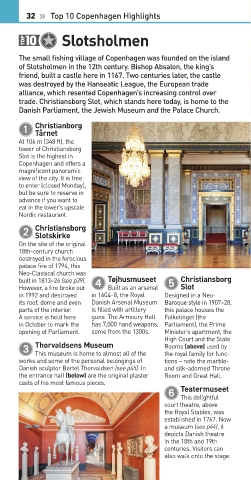
               Slotsholmen

     The small fishing village of Copenhagen was founded on the island
     of Slotsholmen in the 12th century. Bishop Absalon, the king’s
     friend, built a castle here in 1167. Two centuries later, the castle
     was destroyed by the Hanseatic League, the European trade
     alliance, which resented Copenhagen’s increasing control over
     trade. Christiansborg Slot, which stands here today, is home to the
     Danish Parliament, the Jewish Museum and the Palace Church.
         Christianborg
     1
         Tårnet
     At 106 m (348 ft), the
     tower of Christiansborg
     Slot is the highest in
     Copenhagen and offers a
     magnificent panoramic
     view of the city. It is free
     to enter (closed Monday),
     but be sure to reserve in
     advance if you want to
     eat in the tower’s upscale
     Nordic restaurant.
         Christiansborg
     2
         Slotskirke
     On the site of the original
     18th-century church
     destroyed in the fero cious
     palace fire of 1794, this
     Neo-Classical church was
                                          Christiansborg
                         Tøjhusmuseet
     built in 1813–26 (see p39).   4   5
     However, a fire broke out   Built as an arsenal   Slot
     in 1992 and destroyed    in 1604–8, the Royal   Designed in a Neo-
     its roof, dome and even   Danish Arsenal Museum   Baroque style in 1907–28,
     parts of the interior.    is filled with artillery   this palace houses the
     A service is held here    guns. The Armoury Hall   Folketinget (the
     in October to mark the   has 7,000 hand weapons,   Parliament), the Prime
     opening of Parliament.  some from the 1300s.   Minister’s apartment, the
                                      High Court and the State
         Thorvaldsens Museum
     3                                Rooms (above) used by
         This museum is home to almost all of the
                                      the royal family for func-
     works and some of the personal belongings of   tions – note the marble-
     Danish sculp tor Bertel Thorvaldsen (see p45). In    and silk-adorned Throne
     the entrance hall (below) are the original plaster   Room and Great Hall.
     casts of his most famous pieces.
                                          Teatermuseet
                                      6
                                          This delightful
                                      court theatre, above
                                      the Royal Stables, was
                                      established in 1767. Now
                                      a museum (see p44), it
                                      depicts Danish theatre
                                      in the 18th and 19th
                                      centuries. Visitors can
                                      also walk onto the stage.


 032-033_Top_10_Copenhagen.indd   32                  28/02/2018   16:17

