


Page 15 - (DK) Help Your Kids with Language Arts
P. 15
13
                                                     SPOKEN AND  WRIT TEN LANGU AGE


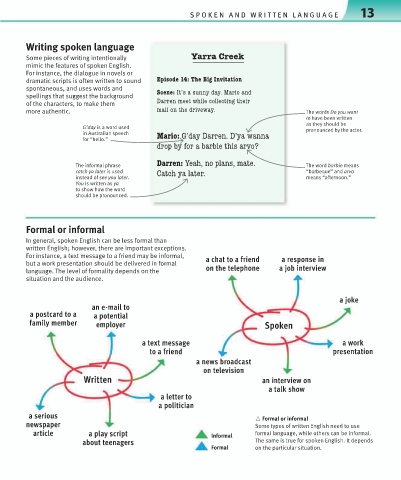
        Writing spoken language

        Some pieces of writing intentionally          AIZZI +ZMMS
        mimic the features of spoken English.
        For instance, the dialogue in novels or
        dramatic scripts is often written to sound   -XQ[WLM   " <PM *QO 1V^Q\I\QWV
        spontaneous, and uses words and     ;KMVM" 1\¼[ I []VVa LIa  5IZQW IVL
        spellings that suggest the background
        of the characters, to make them     ,IZZMV UMM\ _PQTM KWTTMK\QVO \PMQZ
        more authentic.                     UIQT WV \PM LZQ^M_Ia                     The words Do you want
                                                                                     to have been written
                                                                                     as they should be
                        G’day is a word used                                         pronounced by the actor.
                        in Australian speech   5IZQW" /¼LIa ,IZZMV  ,¼aI _IVVI
                        for “hello.”
                                            LZWX Ja NWZ I JIZJQM \PQ[ IZ^W'
                                            ,IZZMV" AMIP  VW XTIV[  UI\M
                      The informal phrase                                            The word barbie means
                      catch ya later is used   +I\KP aI TI\MZ                        “barbeque” and arvo
                      instead of see you later.                                      means “afternoon.”
                      You is written as ya
                      to show how the word
                      should be pronounced.


        Formal or informal
        In general, spoken English can be less formal than
        written English; however, there are important exceptions.
        For instance, a text message to a friend may be informal,    a chat to a friend   a response in
        but a work presentation should be delivered in formal
        language. The level of formality depends on the    on the telephone   a job interview
        situation and the audience.

                                                                                               a joke
                          an e-mail to
         a postcard to a   a potential
         family member      employer                                      Spoken

                                        a text message                                         a work
                                          to a friend                                        presentation
                                                       a news broadcast
                                                         on television
                        Written                                          an interview on
                                                                           a talk show
                                             a letter to
                                             a politician
         a serious                                                     △ Formal or informal
        newspaper                                                      Some types of written English need to use
          article        a play script                     Informal    formal language, while others can be informal.
                        about teenagers                                The same is true for spoken English. It depends
                                                           Formal      on the particular situation.

