


Page 30 - Forbes - Asia (September 2018)
P. 30
PROMOTION


             PURE DIAMOND FARM:


              THE FUTURE OF LAB-GROWN DIAMONDS ENHANCED


                           WITH BLOCKCHAIN TECHNOLOGY IS HERE.

                                         AND IT’S VERY BRIGHT INDEED.


                              Lab-grown, or cultivated, diamonds with the same chemical structure of natural diamonds are
                        gaining popularity in markets such as the U.S. Now Japanese company Pure Diamond Farm is building on

                       existing technology and utilizing blockchain technology to create gems unlike any the world has ever seen.
                      Shigy Ishida, president of Pure Diamond Co., Ltd., and Hideyuki Abe, co-founder of Pure Diamond Lab, Ltd.,
                                  spoke about their plans to bring diamonds made in Japan to the international market.


           Please describe the state of the diamond industry                     they were produced—can be guaranteed, they are also able to
           and its growth potential. How do lab-grown                            offer buyers peace of mind about the ethics of their purchase.
           diamonds fit into the picture?
                                                                                 How did the Pure Diamond Farm project begin?
           Ishida: Japan is the world’s third-largest diamond market,
           at around 680 billion yen (US$6.1 billion). The global market,        Abe: I first heard of lab-grown diamonds from Mr. Ishida, who
           valued at around 8.8 trillion yen (US$79 billion), with the U.S.      knew of their growing popularity in America and approached
           accounting for nearly half. It’s been relatively stable these         me about expanding into Asia. By coincidence, I discovered that
           past  few  years  and  is  expected   to  continue   along   these    there was a maker of cultivated diamonds in Japan and wanted
           lines. However, there are a lot of people who would like to           to introduce Mr. Ishida.
           purchase diamonds that haven’t yet, and we want to tap into
           that sector, for example by making diamonds more accessible           Ishida: Yes, I had originally consulted Mr. Abe about importing
           and increasing opportunities to buy engagement or special             lab-grown diamonds from the U.S. into Japan but hadn’t consid-
           occasion rings.                                                       ered domestically produced gems at all. I figured that while the
                                                                                 technology may exist here, the level of quality probably didn’t
           Abe: Recently, people have become aware of the adverse                compare to those produced in the U.S. However, I was surprised
           effects of diamond mining around the world, such as problems          when they showed me the Japanese diamonds because they
           with the blood-diamond trade, environmental destruction               were incredibly beautiful. I knew that we would have no prob-
           and child labor. There is a new market of consumers who               lem introducing stones of this quality on the international mar-
           want diamonds but don’t want to support harmful practices.            ket. Throughout history, diamonds have always been imported
           Lab-grown diamonds possess the same beauty of natural                 into this country, so I was excited by the prospect of exporting
           diamonds, but because their provenance—when and where                 Japanese-made diamonds overseas.


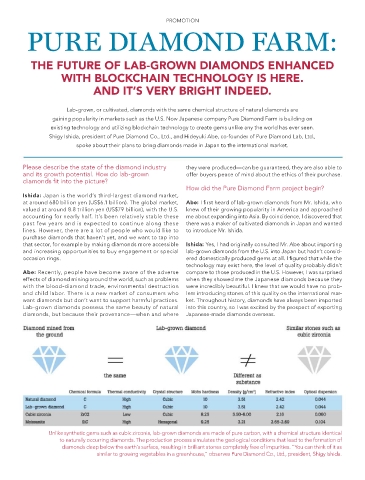
                      Unlike synthetic gems such as cubic zirconia, lab-grown diamonds are made of pure carbon, with a chemical structure identical
                           to naturally occurring diamonds. The production process simulates the geological conditions that lead to the formation of
                            diamonds deep below the earth’s surface, resulting in brilliant stones completely free of impurities. “You can think of it as
                                           similar to growing vegetables in a greenhouse,” observes Pure Diamond Co., Ltd., president, Shigy Ishida.

