


Page 90 - Forbes - Asia (September 2018)
P. 90
The Philippines’ 50 Richest


          BY AURORA ALMENDRAL


           Airports


           & Asphalt


              n the midst of fast growth and an improving investment climate,
              the Philippines is long overdue for a nationwide infrastructure
          Ioverhaul—one which President Rodrigo Duterte hopes will
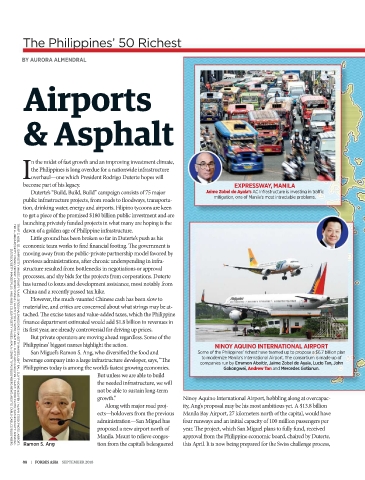
           become part of his legacy.                                                                 EXPRESSWAY, MANILA
              Duterte’s “Build, Build, Build” campaign consists of 75 major               Jaime Zobel de Ayala’s AC Infrastructure is investing in trai  c
                                                                                             mitigation, one of Manila’s most intractable problems.
           public infrastructure projects, from roads to   oodways, transporta-
           tion, drinking water, energy and airports. Filipino tycoons are keen
           to get a piece of the promised $180 billion public investment and are
           launching privately funded projects in what many are hoping is the
           dawn of a golden age of Philippine infrastructure.
              Little ground has been broken so far in Duterte’s push as his


           economic team works to i nd inancial footing. he government is
           moving away from the public-private partnership model favored by
           previous administrations, ater chronic underspending in infra-

           structure resulted from bottlenecks in negotiations or approval
           processes, and shy bids for the projects from corporations. Duterte
           has turned to loans and development assistance, most notably from
           China and a recently passed tax hike.
              However, the much-vaunted Chinese cash has been slow to
           materialize, and critics are concerned about what strings may be at-
           tached. he excise taxes and value-added taxes, which the Philippine


           inance department estimated would add $1.8 billion in revenues in

           its irst year, are already controversial for driving up prices.
              But private operators are moving ahead regardless. Some of the
           Philippines’ biggest names highlight the action.                                   NINOY AQUINO INTERNATIONAL AIRPORT
              San Miguel’s Ramon S. Ang, who diversiied the food and                  Some of the Philippines’ richest have teamed up to propose a  $6.7 billion plan

                                                                                        to modernize Manila’s International Airport. The consortium is made up of
           beverage company into a large infrastructure developer, says, “h e
                                                                                       companies run by Erramon Aboitiz, Jaime Zobel de Ayala, Lucio Tan, John
           Philippines today is among the world’s fastest growing economies.                     Gokongwei, Andrew Tan and Mercedes Gotianun.
                                           But unless we are able to build
                                           the needed infrastructure, we will
                                           not be able to sustain long-term
                                           growth.”                             Ninoy Aquino International Airport, hobbling along at overcapac-
                                              Along with major road proj-       ity, Ang’s proposal may be his most ambitious yet. A $13.8 billion
                                           ects—holdovers from the previous     Manila Bay Airport, 27 kilometers north of the capital, would have
                                           administration—San Miguel has        four runways and an initial capacity of 100 million passengers per

                                           proposed a new airport north of      year. he project, which San Miguel plans to fully fund, received
                                           Manila. Meant to relieve conges-     approval from the Philippine economic board, chaired by Duterte,

           Ramon S. Ang                    tion from the capital’s beleaguered   this April. It is now being prepared for the Swiss challenge process,
      ZI/ISTOCK/GETTY IMAGES PLUS ; ANG: NOEL CELIS/AFP/GETTY IMAGES; AYALA: EDWIN TUYAY/BLOOMBERG NEWS; ABOITIZ: CARLO GABUCO/BLOOMBERG
       TED ALJIBE/AFP/GETTY IMAGES; CEMENT: HISTORIC IMAGES / ALAMY STOCK PHOTO; LIGHT RAIL: DUY PHUONG NGUYEN / ALAMY STOCK PHOTO; WATER FACILITY: ANNAVAC-
         TRAFFIC: NOEL CELIS/AFP/GETTY IMAGES; POWER PLANT: SERGEI MALGAVKO/TASS VIA GETTY IMAGES; LIGHT RAIL: DUY PHUONG NGUYEN / ALAMY STOCK PHOTO; AIRPORT:
           88     |     FORBES ASIA     SEPTEMBER 2018

